
352-001 · Question #772
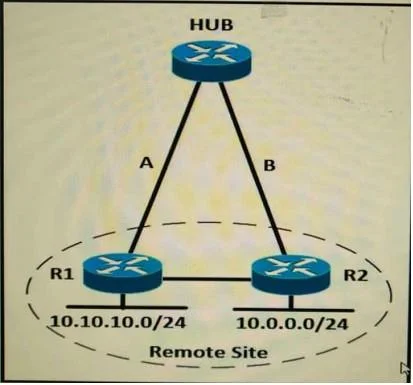
Refer to the exhibit. A customer runs EIGRP and has remote routers with EIGRP stub configured. The customer tests the redundancy by shutting down the B link, and surprisingly the 10.0.0.0/24 subnet…
The correct answer is B. Apply the Stub Route Leaking feature. EIGRP stub suppresses route advertisements to prevent transit routing, but this also hides valid backup routes when a primary link fails - a problem specifically resolved by EIGRP Stub Route Leaking.
Question
Refer to the exhibit. A customer runs EIGRP and has remote routers with EIGRP stub configured. The customer tests the redundancy by shutting down the B link, and surprisingly the 10.0.0.0/24 subnet is no longer accessed by the hub router. Which action resolves this issue?
Exhibit
Options
- AWait for a few seconds, after the EIGRP dead timer expired between R2 and hub, the
- BApply the Stub Route Leaking feature
- CRemove summarization from all routers
- DRemove the EIGRP stub option, because it is not possible to configure two EIGRP stub routers
How the community answered
(20 responses)- A5% (1)
- B80% (16)
- C10% (2)
- D5% (1)
Why each option
EIGRP stub suppresses route advertisements to prevent transit routing, but this also hides valid backup routes when a primary link fails - a problem specifically resolved by EIGRP Stub Route Leaking.
Waiting for the EIGRP dead timer does not resolve the issue because the root cause is the stub configuration suppressing route advertisements, not a neighbor adjacency or convergence timing problem.
EIGRP Stub Route Leaking allows a stub router to selectively advertise specific prefixes to the hub, overriding the default stub suppression behavior. Without this feature, when link B fails the stub router silently withholds the advertisement for 10.0.0.0/24 even though an alternate path exists, making the subnet unreachable from the hub; enabling stub route leaking permits that specific prefix to be propagated.
Removing summarization does not address the stub behavior that prevents the router from advertising EIGRP-learned routes to its hub neighbor.
Deploying multiple EIGRP stub routers in a hub-and-spoke topology is a valid and supported design; the problem is the route suppression behavior of stub, not the number of stub routers present.
Concept tested: EIGRP stub route leaking for redundancy recovery
Source: https://www.cisco.com/c/en/us/td/docs/ios-xml/ios/iproute_eigrp/configuration/xe-16/ire-xe-16-book/ire-eigrp-stub-rtg.html
Topics
Community Discussion
No community discussion yet for this question.