
352-001 · Question #670
Refer to the exhibit. The customer uses Gigabit Ethernet on all router interfaces and gets point-to- point Layer 2 VPN connections from their Telco. This network runs IS-IS with default parameters…
The correct answer is A. between router B and router D C. between router F and router G. IS-IS assigns a default metric of 10 to every interface regardless of bandwidth; decreasing the metric on the two circuits that form the high-speed path between router A and router H directs bidirectional traffic onto those links.
Question
Refer to the exhibit. The customer uses Gigabit Ethernet on all router interfaces and gets point-to- point Layer 2 VPN connections from their Telco. This network runs IS-IS with default parameters. In which to circuits should you manually decrease the interface metric to allow bidirectional traffic to take the high- speed links between router A and router H? (Choose two.)
Exhibit
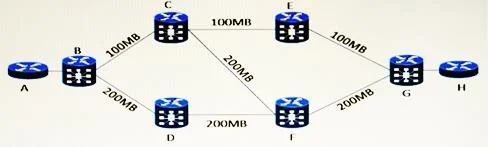
Options
- Abetween router B and router D
- Bbetween router D and router F
- Cbetween router F and router G
- Dbetween router C and router F
How the community answered
(36 responses)- A53% (19)
- B17% (6)
- D31% (11)
Why each option
IS-IS assigns a default metric of 10 to every interface regardless of bandwidth; decreasing the metric on the two circuits that form the high-speed path between router A and router H directs bidirectional traffic onto those links.
Decreasing the metric on the B-D circuit lowers the cost of that segment on the high-speed path toward router H, making it the preferred route for traffic originating from the A side.
The D-F circuit is not on the direct high-speed path between router A and router H in the described topology, so lowering its metric would not direct traffic onto the correct high-speed links.
Decreasing the metric on the F-G circuit completes the lower-cost high-speed path in the reverse direction, ensuring bidirectional traffic uses the intended high-speed links between router A and router H.
The C-F circuit represents an alternate path that bypasses the desired high-speed route; lowering its metric could attract traffic away from the intended high-speed links rather than toward them.
Concept tested: IS-IS manual interface metric tuning for path selection
Source: https://www.cisco.com/c/en/us/td/docs/ios-xml/ios/iproute_isis/configuration/xe-16/irs-xe-16-book/irs-cfg-is-is.html
Topics
Community Discussion
No community discussion yet for this question.