
352-001 · Question #644
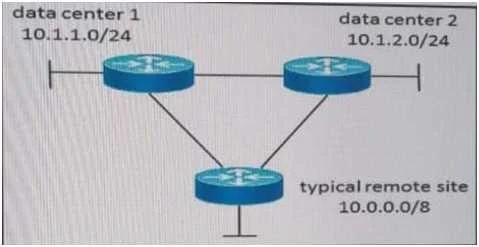
Refer to the exhibit. A customer currently has a large EIGRP-based network with several remote sites attached. All remote sites connect to the two corporate data centers, depicted as 10.1.1.0 and…
The correct answer is A. Set the data center routers as stub-routers B. Perform summarization at the data centers, selectively leaking routes sent to the remote sites. In an EIGRP hub-and-spoke design suffering from stuck-in-active and instability, configuring stub routing at data centers limits query scope while summarization at data centers reduces routing table size on remote routers.
Question
Refer to the exhibit. A customer currently has a large EIGRP-based network with several remote sites attached. All remote sites connect to the two corporate data centers, depicted as 10.1.1.0 and 10.1.2.0. The customer has experienced several network-wide failures where neighbors were stuck-in-active and had other network stability issues due to some links flapping. Which two redesign options increase stability and reduce the load on the remote site routers, still maintaining optimal routing between remote sites and the two data centers? (Choose two)
Exhibit
Options
- ASet the data center routers as stub-routers
- BPerform summarization at the data centers, selectively leaking routes sent to the remote sites
- CPerform summarization at the remote sites, selectively leaking routes sent to the data centers
- DSet the hello interval timer to be larger than the hold interval
- EIncrease the hold interval to accommodate lost hello packets on error-prone links
How the community answered
(63 responses)- A44% (28)
- C8% (5)
- D17% (11)
- E30% (19)
Why each option
In an EIGRP hub-and-spoke design suffering from stuck-in-active and instability, configuring stub routing at data centers limits query scope while summarization at data centers reduces routing table size on remote routers.
Configuring EIGRP stub on the data center routers constrains EIGRP query propagation so that queries do not bounce between data centers or flood the entire network, directly eliminating the stuck-in-active condition that occurs when remote site routers cannot reply to active queries within the active timer.
Performing summarization at the data centers and selectively leaking only necessary specific routes to remote sites reduces the number of prefixes remote site routers must maintain in their topology tables, lowering CPU and memory consumption while preserving optimal path selection to both data centers.
Summarization at remote sites toward the data centers does not reduce the routing table load on the remote routers themselves and does nothing to limit the EIGRP query scope that causes stuck-in-active events.
Setting the hello interval larger than the hold interval is a fatal misconfiguration - the hold timer must always exceed the hello interval, otherwise the hold timer expires before a new hello arrives, causing unnecessary adjacency resets.
Increasing only the hold interval may reduce false adjacency drops on flapping links but does not shrink the routing table or limit query propagation, so it does not reduce load on remote site routers or address stuck-in-active.
Concept tested: EIGRP stub routing and summarization for hub-and-spoke stability
Source: https://www.cisco.com/c/en/us/td/docs/ios-xml/ios/iproute_eigrp/configuration/xe-16/ire-xe-16-book/ire-stub-rtg.html
Topics
Community Discussion
No community discussion yet for this question.