
352-001 · Question #590
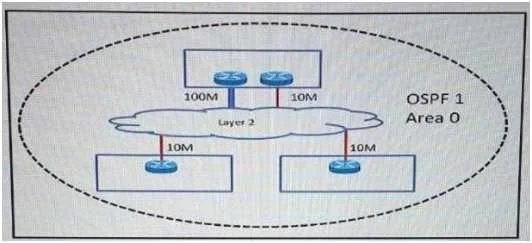
Refer to the exhibit. An enterprise has three sites over a Layer 2 Metro Ethernet ELAN service. 100Mb/s and 10 Mb/s links have been provisioned to provide redundancy for the head office. When OSPF…
The correct answer is C. Point-to-point. Setting the OSPF network type to point-to-point on each link eliminates DR/BDR election and ensures each link cost is calculated individually based on bandwidth, making the 100 Mb/s link preferred with minimal configuration.
Question
Refer to the exhibit. An enterprise has three sites over a Layer 2 Metro Ethernet ELAN service. 100Mb/s and 10 Mb/s links have been provisioned to provide redundancy for the head office. When OSPF routing enabled to provide connectivity and the correct bandwidth statement has been applied to each interface, the branch sites observe two equal-cost routes to the head office. The enterprise wants to send all traffic through the 100 Mb/s link and use the 10Mb/S link strictly as a backup. Which OSPF network type must be set to ensure that the head office 100 Mb/s circuit is preferred over the 10 Mb/s circuit, at the same time minimize the amount of configuration required on all of the routers throughout the network?
Exhibit
Options
- ANBMA
- BPoint-to-multipoint
- CPoint-to-point
- DBroadcast
How the community answered
(63 responses)- A6% (4)
- B3% (2)
- C78% (49)
- D13% (8)
Why each option
Setting the OSPF network type to point-to-point on each link eliminates DR/BDR election and ensures each link cost is calculated individually based on bandwidth, making the 100 Mb/s link preferred with minimal configuration.
NBMA network type requires manually configured neighbor statements on the hub router and still involves DR/BDR election, significantly increasing configuration complexity across the network.
Point-to-multipoint network type avoids DR/BDR election but generates additional host routes and introduces more configuration overhead than point-to-point, making it a less efficient choice for this design.
With the point-to-point OSPF network type, each link is treated as a dedicated connection with its own cost derived from the configured bandwidth - the 100 Mb/s link receives a lower OSPF cost than the 10 Mb/s link, causing OSPF to prefer it as the primary path. Point-to-point type requires no DR/BDR election, eliminating that configuration overhead across all routers in the Metro Ethernet ELAN. This combination of accurate cost differentiation and reduced configuration overhead satisfies both requirements of the enterprise design.
Broadcast network type on a Metro Ethernet ELAN treats all sites as belonging to a single shared segment with one DR/BDR, causing OSPF to compute equal-cost paths rather than differentiating the costs of the 100 Mb/s and 10 Mb/s links individually.
Concept tested: OSPF point-to-point network type for link cost differentiation
Source: https://www.cisco.com/c/en/us/support/docs/ip/open-shortest-path-first-ospf/7039-1.html
Topics
Community Discussion
No community discussion yet for this question.