
352-001 · Question #59
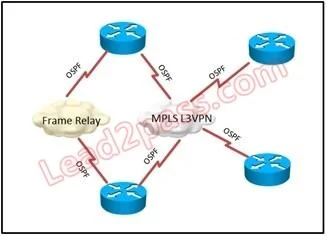
Refer to the exhibit. An enterprise is migrating its single-area OSPF network from a Frame Relay WAN service to an MPLS L3VPN service. Frame Relay will remain in only a few sites that require…
The correct answer is B. sham links. OSPF sham links are required to make the MPLS L3VPN path appear as an intra-area OSPF route so it is preferred over the backdoor Frame Relay connection during normal operation.
Question
Refer to the exhibit. An enterprise is migrating its single-area OSPF network from a Frame Relay WAN service to an MPLS L3VPN service. Frame Relay will remain in only a few sites that require increased resiliency via two different WAN connections. Which feature could be used in the ? MPLS VPN service provider network to support the design requirement by ensuring that during normal operation, intersite traffic will only use the MPLS VPN service and not the old Frame Relay service?
Exhibit
Options
- Avirtual links
- Bsham links
- Cmultiple stub areas
- Dsuper backbone
How the community answered
(20 responses)- A5% (1)
- B60% (12)
- C10% (2)
- D25% (5)
Why each option
OSPF sham links are required to make the MPLS L3VPN path appear as an intra-area OSPF route so it is preferred over the backdoor Frame Relay connection during normal operation.
Virtual links connect a discontiguous OSPF area to the backbone (area 0) when direct connectivity is unavailable and do not influence path preference between MPLS L3VPN and a backdoor Frame Relay link.
Without sham links, OSPF routes redistributed through BGP in the MPLS L3VPN core reappear at the remote PE as inter-area (LSA Type 3) or external (LSA Type 5) routes, while the backdoor Frame Relay connection advertises intra-area routes. Because OSPF always prefers intra-area over inter-area and external routes, traffic would use Frame Relay instead of MPLS. A sham link is a virtual OSPF link configured between PE routers within the same VRF, causing the MPLS path to appear as an intra-area connection and allowing cost-based preference to direct traffic over MPLS during normal operation.
Configuring multiple stub areas restricts external LSA flooding and alters the topology of the routing domain, but does not resolve the route-type preference issue that causes traffic to favor the Frame Relay backdoor path.
Super backbone is not a standard OSPF feature; while the MPLS provider network can function as an extended backbone, this concept alone does not address the intra-area vs. inter-area preference problem that drives traffic to the Frame Relay backdoor.
Concept tested: OSPF sham links for MPLS L3VPN backdoor link preference
Source: https://www.cisco.com/c/en/us/td/docs/ios-xml/ios/iproute_ospf/configuration/xe-16/iro-ospf-xe-16-book/iro-ospf-sham-links.html
Topics
Community Discussion
No community discussion yet for this question.