
352-001 · Question #457
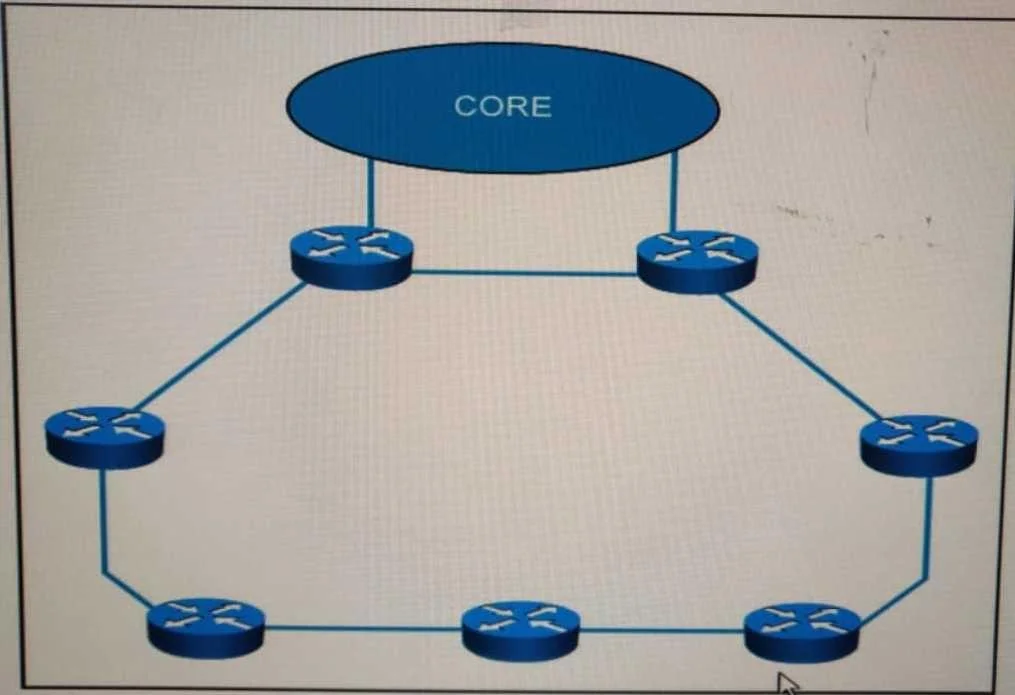
Refer to the exhibit. You must design this network for IP Fast Reroute by enabling the OSPF Loop-Free Alternates feature (not Remote Loop-Free Alternates). Which two options are concerns about the…
The correct answer is A. OSPF Loop-Free Alternates is not supported on ring topologies. D. The solution is prone to microloops in case of congestion. OSPF Loop-Free Alternates cannot reliably provide valid alternates on ring topologies, and ring designs are also susceptible to microloops during convergence events.
Question
Refer to the exhibit. You must design this network for IP Fast Reroute by enabling the OSPF Loop-Free Alternates feature (not Remote Loop-Free Alternates). Which two options are concerns about the proposed solution? (Choose 2)
Exhibit
Options
- AOSPF Loop-Free Alternates is not supported on ring topologies.
- BOSPF Loop-Free Alternates on ring topologies are prone to routing loops.
- CFast Reroute requires MPLS TE.
- DThe solution is prone to microloops in case of congestion
- EOSPF Loop-Free Alternates is transport dependent.
How the community answered
(26 responses)- A46% (12)
- B15% (4)
- C8% (2)
- E31% (8)
Why each option
OSPF Loop-Free Alternates cannot reliably provide valid alternates on ring topologies, and ring designs are also susceptible to microloops during convergence events.
On ring topologies, OSPF LFA cannot satisfy the loop-free inequality condition (downstream path criterion) because the only alternate path available traverses the same ring segment, meaning no valid LFA next-hop can be computed and Fast Reroute protection is not achieved.
The primary concern with rings is that LFA simply fails to find valid alternates, not that it actively creates routing loops - the routing loop risk is a separate microloop concern during convergence.
OSPF LFA does not require MPLS TE; MPLS TE is required only for MPLS TE FRR or Remote LFA (rLFA) extensions, not for basic LFA.
Ring topologies introduce microloop risk during link or node failures because traffic can temporarily loop around the ring as nodes update their routing tables at different times during convergence, especially under congestion conditions.
OSPF LFA is transport independent and operates purely at the IP routing layer without any dependency on the underlying transport technology.
Concept tested: OSPF LFA limitations on ring topologies
Source: https://www.cisco.com/c/en/us/td/docs/ios-xml/ios/iproute_ospf/configuration/xe-16/iro-xe-16-book/iro-lfa-frr.html
Topics
Community Discussion
No community discussion yet for this question.