
352-001 · Question #41
Refer to the exhibit. You are developing a migration plan to enable IPv6 in your IPv4 network. Starting at R3 and assuming default IS-IS operations, what is likely to happen when you enable IPv6…
The correct answer is C. Loopback reachability between all routers for IPv4 is lost. In default IS-IS single-topology mode, enabling IPv6 on only one link creates an address-family inconsistency across the topology, causing IS-IS adjacencies to reset and breaking IPv4 loopback reachability for all routers.
Question
Refer to the exhibit. You are developing a migration plan to enable IPv6 in your IPv4 network. Starting at R3 and assuming default IS-IS operations, what is likely to happen when you enable IPv6 routing on the link from R3 to R2?
Exhibit
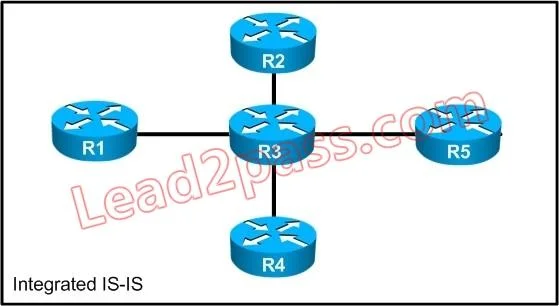
Options
- AOnly R3 and R2 have IPv4 and IPv6 reachability.
- BR2 receives an IPv6 default route from R3.
- CLoopback reachability between all routers for IPv4 is lost.
- DAll routers except R2 are reachable through IPv4.
- ER3 advertises the link from R3-R2 to R1, R4 and R5 only.
How the community answered
(40 responses)- A10% (4)
- B5% (2)
- C63% (25)
- D20% (8)
- E3% (1)
Why each option
In default IS-IS single-topology mode, enabling IPv6 on only one link creates an address-family inconsistency across the topology, causing IS-IS adjacencies to reset and breaking IPv4 loopback reachability for all routers.
Single-topology IS-IS does not isolate reachability to only the two routers on the new IPv6 link - the topology-wide adjacency reset affects all routers, not just R3 and R2.
IS-IS does not automatically generate or advertise an IPv6 default route to R2 when IPv6 is enabled on an interface - default route origination requires explicit configuration.
IS-IS default single-topology mode requires all interfaces and routers in the domain to consistently support the same address families within a shared SPF calculation. Enabling IPv6 only on the R3-R2 link creates an inconsistency that causes IS-IS to reset adjacencies across the topology. This adjacency reset disrupts the IS-IS database, resulting in loopback reachability loss for IPv4 across all routers in the domain.
The adjacency reset caused by the single-topology inconsistency affects all routers in the IS-IS domain, not just R2, so this answer incorrectly scopes the impact.
IS-IS is a link-state protocol that floods LSPs to all routers in the domain - it does not selectively advertise the R3-R2 link only to specific neighbors like R1, R4, and R5.
Concept tested: IS-IS single-topology IPv6 migration adjacency impact
Source: https://www.cisco.com/c/en/us/td/docs/ios-xml/ios/iproute_isis/configuration/xe-16/iri-xe-16-book/iri-ipv6-mt.html
Topics
Community Discussion
No community discussion yet for this question.