
352-001 · Question #377
Refer to the exhibit. After this new OSPF design with per-packet load balancing was implemented, Host A reported that large file downloads from Server A became slow and sometimes failed. The…
The correct answer is D. Adjust the OSPF auto-cost reference bandwidth on all routers. Per-packet load balancing causes out-of-order delivery when equal-cost paths exist; adjusting the OSPF auto-cost reference bandwidth on all routers eliminates ECMP by making link costs unequal.
Question
Refer to the exhibit. After this new OSPF design with per-packet load balancing was implemented, Host A reported that large file downloads from Server A became slow and sometimes failed. The operations team discovered that packets are arriving out of order on R1. Which cost-conscious redesign action will fix the issue?
Exhibit
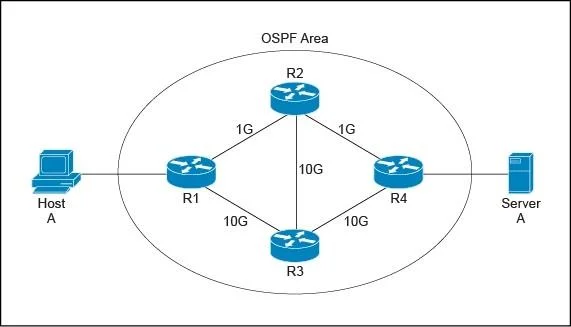
Options
- AUpgrade all links to 10 Gb/s.
- BAdjust MTU sizes to 1500 on all interfaces.
- CAdjust the OSPF auto-cost reference bandwidth on R4.
- DAdjust the OSPF auto-cost reference bandwidth on all routers.
How the community answered
(27 responses)- A4% (1)
- B19% (5)
- C11% (3)
- D67% (18)
Why each option
Per-packet load balancing causes out-of-order delivery when equal-cost paths exist; adjusting the OSPF auto-cost reference bandwidth on all routers eliminates ECMP by making link costs unequal.
Upgrading all links to 10 Gb/s is not cost-conscious and may not eliminate ECMP if the upgraded links still compute equal OSPF costs.
Setting MTU to 1500 on all interfaces does not affect OSPF cost calculations or path selection and will not stop per-packet load balancing.
Adjusting the reference bandwidth only on R4 produces inconsistent cost calculations relative to the rest of the network, risking routing loops and suboptimal path selection without reliably eliminating ECMP.
Adjusting the auto-cost reference bandwidth on all routers recalculates interface costs consistently across the entire topology, which can break the cost equality that enables ECMP and per-packet load balancing. Without equal-cost paths, OSPF selects a single best path, ensuring packets traverse one route and arrive in order. The change must be applied to all routers to prevent inconsistent cost calculations that could cause routing loops or suboptimal forwarding.
Concept tested: OSPF auto-cost reference bandwidth and ECMP path selection
Source: https://www.cisco.com/c/en/us/support/docs/ip/open-shortest-path-first-ospf/7039-1.html
Topics
Community Discussion
No community discussion yet for this question.