
352-001 · Question #366
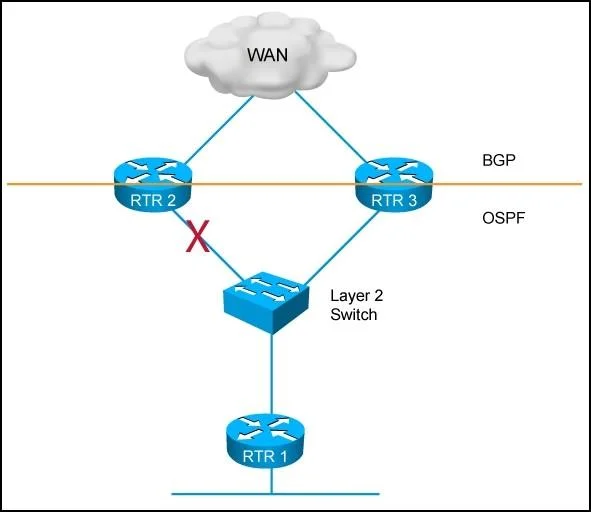
Refer to the exhibit. RTR 1 uses RTR 2 as the primary WAN exit point. When a failure occurs in the link connected to RTR 2 LAN, it takes about 40 seconds for RTR 1 to use the backup path via RTR 3…
The correct answer is C. Use BFD with OSPF between RTR 1 and RTR 2. E. Tune OSPF fast hello on all the routers. BFD and OSPF fast hellos are the two independent mechanisms that can reduce OSPF failure detection to sub-second intervals on the RTR1-RTR2 link.
Question
Refer to the exhibit. RTR 1 uses RTR 2 as the primary WAN exit point. When a failure occurs in the link connected to RTR 2 LAN, it takes about 40 seconds for RTR 1 to use the backup path via RTR 3. Which two mechanisms can be used independently to improve the failure detection time to 1 second or less when RTR 1 failover to RTR3? (Choose two.)
Exhibit
Options
- AConfigure EEM on RTR 2.
- BChange OSPF throttling timer.
- CUse BFD with OSPF between RTR 1 and RTR 2.
- DUse BFD with OSPF between RTR 2 and RTR 3.
- ETune OSPF fast hello on all the routers.
How the community answered
(34 responses)- A3% (1)
- B6% (2)
- C82% (28)
- D9% (3)
Why each option
BFD and OSPF fast hellos are the two independent mechanisms that can reduce OSPF failure detection to sub-second intervals on the RTR1-RTR2 link.
EEM on RTR2 could script a reaction to a local event, but RTR2 is on the failing path and EEM does not independently accelerate failure detection on RTR1.
OSPF throttling timers control SPF recalculation rate, not the hello or dead interval timers used for neighbor failure detection.
BFD (Bidirectional Forwarding Detection) is a lightweight hello protocol that operates independently of OSPF and can detect link failures in milliseconds (as low as 50ms with aggressive timers). When configured between RTR1 and RTR2, BFD signals OSPF immediately upon detecting the failure, triggering a reroute via RTR3 well under 1 second.
BFD between RTR2 and RTR3 would accelerate detection on that segment, but it does not help RTR1 detect the failure of the link connecting it to RTR2.
OSPF fast hello packets (sub-second hello intervals using the 'ip ospf dead-interval minimal hello-multiplier' command) allow the dead timer to expire in less than 1 second, enabling OSPF itself to detect and react to the RTR2 link failure within the 1-second target.
Concept tested: Sub-second OSPF failure detection using BFD and fast hellos
Source: https://www.cisco.com/c/en/us/support/docs/ip/bidirectional-forwarding-detection-bfd/113819-bfd-for-ospf-00.html
Topics
Community Discussion
No community discussion yet for this question.