
352-001 · Question #362
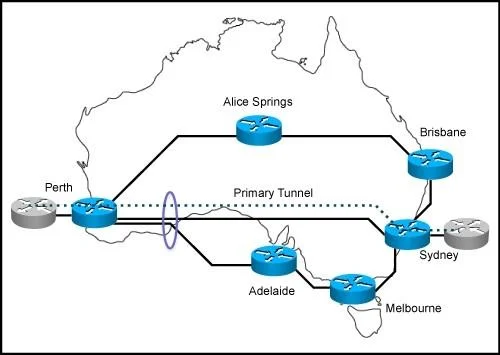
Refer to the exhibit. You are designing MPLS-TE for this network. The links from Perth to Sydney and from Perth to Adelaide share the same optical fiber in one given segment. Which feature should…
The correct answer is D. Shared Risk Link Groups. Shared Risk Link Groups (SRLG) allow MPLS-TE to identify links sharing a common physical resource so that backup tunnels are never computed over the same optical fiber as the primary tunnel.
Question
Refer to the exhibit. You are designing MPLS-TE for this network. The links from Perth to Sydney and from Perth to Adelaide share the same optical fiber in one given segment. Which feature should you implement to eliminate the risk that a backup tunnel is installed over the same optical fiber as the primary one?
Exhibit
Options
- ADiffServ Traffic Engineering
- BForwarding Adjacency
- CMPLS-TE Path Protection
- DShared Risk Link Groups
- EMPLS-TE Link Protection
How the community answered
(30 responses)- A17% (5)
- B3% (1)
- C3% (1)
- D70% (21)
- E7% (2)
Why each option
Shared Risk Link Groups (SRLG) allow MPLS-TE to identify links sharing a common physical resource so that backup tunnels are never computed over the same optical fiber as the primary tunnel.
DiffServ-TE enables differentiated QoS bandwidth pools for traffic classes within MPLS-TE but provides no mechanism to detect or avoid shared physical resources between primary and backup paths.
Forwarding Adjacency advertises an MPLS-TE tunnel as an IGP link to enable hierarchical TE topologies but does not constrain path computation away from links sharing physical fiber.
MPLS-TE Path Protection pre-computes a standby tunnel end-to-end, but without SRLG the backup path computation has no awareness of shared fiber and may still traverse the same optical segment.
SRLG is specifically designed for scenarios where multiple logical links share a common physical medium such as optical fiber. By assigning the Perth-to-Sydney and Perth-to-Adelaide links to the same SRLG, RSVP-TE path computation will exclude any link belonging to that group when selecting a backup path, guaranteeing the backup tunnel avoids the shared fiber segment.
MPLS-TE Link Protection provides fast-reroute local repair around a failed link but does not inherently prevent the alternate segment from sharing the same physical fiber unless SRLG constraints are also applied.
Concept tested: MPLS-TE Shared Risk Link Groups for physical path diversity
Source: https://www.cisco.com/c/en/us/td/docs/ios-xml/ios/mp_te_path_setup/configuration/xe-16/mp-te-path-setup-xe-16-book/mp-te-srlg.html
Topics
Community Discussion
No community discussion yet for this question.