
352-001 · Question #320
Refer to the exhibit. This new OSPF network has four areas, but the hub-and-spoke area experiences frequent flapping. You must fix this design failure. Which two mechanisms can you use to isolate…
The correct answer is A. Make the DC area totally stub. D. Deploy a prefix summarization on router D. To isolate the stable DC area from LSA flooding caused by hub-and-spoke instability, the design must use OSPF area type restrictions and route summarization to contain churn at area boundaries.
Question
Refer to the exhibit. This new OSPF network has four areas, but the hub-and-spoke area experiences frequent flapping. You must fix this design failure. Which two mechanisms can you use to isolate the data center area from the hub-and-spoke area without losing IP connectivity? (Choose two.)
Exhibit
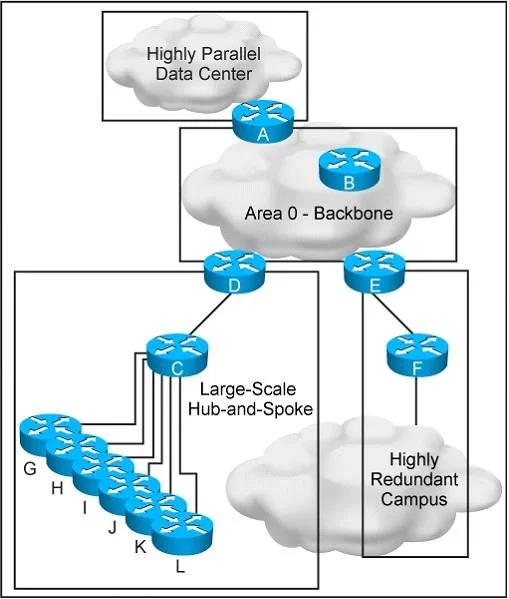
Options
- AMake the DC area totally stub.
- BMake the DC area an NSSA.
- CConvert the DC area to EIGRP protocol.
- DDeploy a prefix summarization on router D.
- EUse OSPF distribute-list filtering on router A.
How the community answered
(29 responses)- A55% (16)
- B7% (2)
- C28% (8)
- E10% (3)
Why each option
To isolate the stable DC area from LSA flooding caused by hub-and-spoke instability, the design must use OSPF area type restrictions and route summarization to contain churn at area boundaries.
Configuring the DC area as totally stub blocks all Type 3 summary LSAs and Type 4/5 external LSAs from entering the area, ensuring that route flaps in the hub-and-spoke area cannot generate LSA updates that propagate into the DC area.
An NSSA still receives Type 3 summary LSAs generated by the backbone ABR, meaning routing instability from the hub-and-spoke area can still propagate into the DC area through ABR-originated summary advertisements.
Converting the DC area to EIGRP would require mutual redistribution at the boundary, introducing a different failure domain rather than isolating the existing OSPF instability and potentially causing routing loops or suboptimal paths.
Deploying prefix summarization on the ABR (router D) aggregates multiple specific prefixes into a single summary LSA, so individual route flaps within the hub-and-spoke area do not trigger new LSA flooding into the backbone or adjacent areas.
An OSPF distribute-list filters specific prefixes from the local routing table on a single router but does not suppress LSA flooding throughout the area, so hub-and-spoke instability continues to propagate as LSA updates across all routers.
Concept tested: OSPF area isolation using totally stub and summarization
Source: https://www.cisco.com/c/en/us/support/docs/ip/open-shortest-path-first-ospf/13703-8.html
Topics
Community Discussion
No community discussion yet for this question.