
352-001 · Question #311
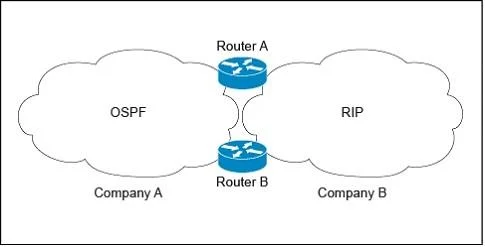
Refer to the exhibit. Company A is running a single-area OSPF, and Company B is running RIP as the IGP with no overlapping IP address spaces. Company A has just acquired Company B and both networks…
The correct answer is B. Enable mutual redistribution between OSPF and RIP on Router A and Router B using route tags. C. Increase the administrative distance to 130 for the OSPF external prefixes on Router A and E. Filter external routes on Router A and Router B based on route tags. Merging OSPF and RIP domains with dual border routers requires route tags and administrative distance tuning to guarantee both redundancy and loop-free redistribution.
Question
Refer to the exhibit. Company A is running a single-area OSPF, and Company B is running RIP as the IGP with no overlapping IP address spaces. Company A has just acquired Company B and both networks must be merged. Which three design components are recommended to guarantee connectivity and redundancy between the two networks? (Choose three.)
Exhibit
Options
- AEnable mutual redistribution between OSPF and RIP on one border router.
- BEnable mutual redistribution between OSPF and RIP on Router A and Router B using route tags.
- CIncrease the administrative distance to 130 for the OSPF external prefixes on Router A and
- DImplement an ACL on Router A and Router B to prevent OSPF external routes from being
- EFilter external routes on Router A and Router B based on route tags.
How the community answered
(54 responses)- A24% (13)
- B63% (34)
- D13% (7)
Why each option
Merging OSPF and RIP domains with dual border routers requires route tags and administrative distance tuning to guarantee both redundancy and loop-free redistribution.
Configuring redistribution on only one border router eliminates redundancy, violating the explicit design requirement for redundancy between the two merged networks.
Enabling mutual redistribution on both Router A and Router B provides redundancy if one border router fails, while attaching route tags during redistribution marks routes with their origin domain. This tagging is the foundation for preventing redistributed routes from looping back into their source domain.
OSPF external routes (redistributed from RIP) normally share the same administrative distance of 110 as internal OSPF routes, creating selection ambiguity. Raising the AD of OSPF external routes to 130 ensures that internally learned OSPF routes are always preferred over externally redistributed ones, preventing suboptimal path selection.
Blocking all OSPF external routes with an ACL would prevent legitimate redistributed prefixes from being advertised, breaking connectivity between the two networks rather than simply preventing loops.
Tag-based filtering on both border routers allows each router to identify routes that were already redistributed from the opposite domain and drop them before re-redistribution. This is the standard mechanism to break potential routing loops when mutual redistribution is configured on multiple routers.
Concept tested: Mutual redistribution with route tags to prevent routing loops
Source: https://www.cisco.com/c/en/us/support/docs/ip/open-shortest-path-first-ospf/13659-17.html
Topics
Community Discussion
No community discussion yet for this question.