
352-001 · Question #308
Refer to the exhibit. Four customer sites are connected through an EoMPLS-based VPLS over an MPLS provider. You are migrating from OSPF to multi-level IS-IS as the routing protocol to run on the…
The correct answer is A. The DIS role for Level1 and Level2 can be performed by different routers. C. One of the CE routers will be elected as the DIS based on interface priority then highest MAC. In IS-IS, DIS election on a multi-access segment like VPLS follows a specific algorithm and the roles are independent per level, which must be understood to control which CE is elected.
Question
Refer to the exhibit. Four customer sites are connected through an EoMPLS-based VPLS over an MPLS provider. You are migrating from OSPF to multi-level IS-IS as the routing protocol to run on the four CE routers, and connectivity between all four sites is required. You want to control which CE or CEs will be elected as the Designated Intermediate System. Which two key aspects should be taken into account? (Choose two.)
Exhibit
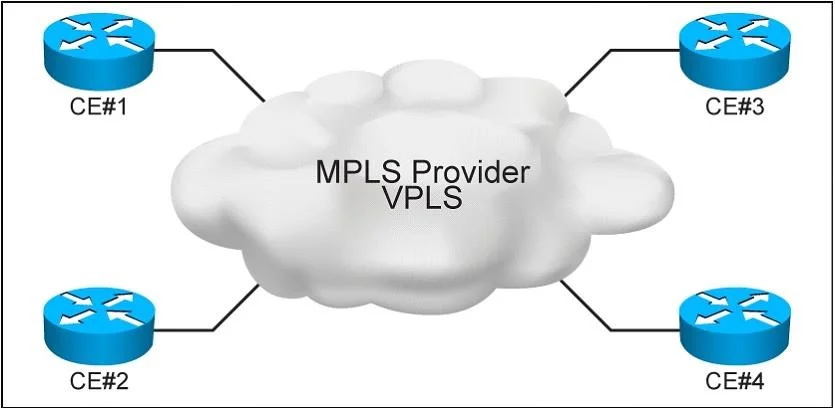
Options
- AThe DIS role for Level1 and Level2 can be performed by different routers.
- BThe CE with the second highest priority will be elected as the backup DIS on the LAN segment.
- COne of the CE routers will be elected as the DIS based on interface priority then highest MAC
- DIt is recommended to use point-to-point link type on the CEs.
- EIf a new CE router is added to the VPLS cloud with a lower interface priority it will become the
How the community answered
(60 responses)- A52% (31)
- B30% (18)
- D12% (7)
- E7% (4)
Why each option
In IS-IS, DIS election on a multi-access segment like VPLS follows a specific algorithm and the roles are independent per level, which must be understood to control which CE is elected.
IS-IS independently elects a DIS for each level (Level 1 and Level 2) on a multi-access segment, so the same router does not have to serve both roles - this differs from OSPF where a single DR serves all adjacency types on a segment.
IS-IS does not have a Backup DIS concept - all non-DIS routers form full adjacencies with each other via the pseudonode, unlike OSPF which has a BDR; any router can immediately take over if the DIS fails.
The IS-IS DIS election algorithm first compares interface priority (highest wins), and only uses the highest MAC address (SNPA) as a tiebreaker when priorities are equal, giving administrators a deterministic way to control which CE is elected.
The VPLS cloud presents a multi-access LAN segment to the CEs, so using point-to-point link type would bypass DIS election entirely rather than helping control it, which contradicts the requirement to manage DIS election.
In IS-IS, DIS election is preemptive - if a new router joins with a higher priority it immediately becomes the DIS; a lower priority router would not take over, making this answer incomplete or misleading as stated.
Concept tested: IS-IS DIS election on multi-access segments
Source: https://www.cisco.com/c/en/us/support/docs/ip/integrated-intermediate-system-to-intermediate-system-is-is/13795-des-is-is.html
Topics
Community Discussion
No community discussion yet for this question.