
352-001 · Question #287
Refer to the exhibit. After this new OSPF design with per-packet load balancing was implemented, Host A reported that large file downloads from Server A became slow and sometimes failed. The…
The correct answer is D. Adjust the OSPF auto-cost reference bandwidth on all routers. OSPF auto-cost reference bandwidth must be set consistently on every router in the domain; inconsistent values produce asymmetric link costs that maintain equal-cost paths, which drives per-packet load balancing and causes packet reordering.
Question
Refer to the exhibit. After this new OSPF design with per-packet load balancing was implemented, Host A reported that large file downloads from Server A became slow and sometimes failed. The operations team discovered that packets are arriving out of order on R1. Which cost-conscious redesign action will fix the issue?
Exhibit
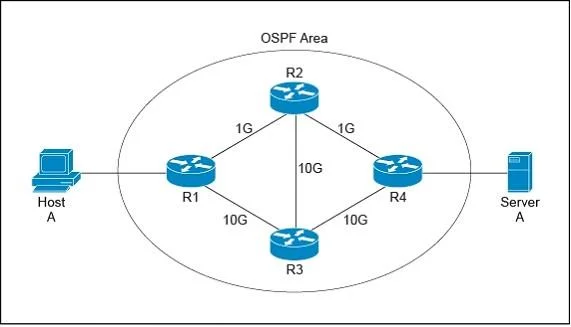
Options
- AUpgrade all links to 10 Gbps.
- BAdd an IP SLA probe on R1 and R4.
- CAdjust the OSPF auto-cost reference bandwidth on R4.
- DAdjust the OSPF auto-cost reference bandwidth on all routers.
How the community answered
(56 responses)- A5% (3)
- B14% (8)
- C23% (13)
- D57% (32)
Why each option
OSPF auto-cost reference bandwidth must be set consistently on every router in the domain; inconsistent values produce asymmetric link costs that maintain equal-cost paths, which drives per-packet load balancing and causes packet reordering.
Upgrading all links to 10 Gbps is not cost-conscious and does not inherently eliminate equal-cost paths; it increases bandwidth but does not resolve the per-packet reordering caused by ECMP.
IP SLA probes provide monitoring and can trigger tracked route changes but do not alter OSPF cost calculations or remove equal-cost paths from the routing table.
Changing the reference bandwidth only on R4 creates asymmetric cost calculations between R4 and the rest of the OSPF domain, which introduces routing inconsistencies rather than resolving them.
OSPF calculates link cost as reference-bandwidth divided by interface bandwidth. When different routers use different reference-bandwidth values, they derive different costs for the same links, causing inconsistent ECMP path selection across the topology. Adjusting the auto-cost reference bandwidth uniformly on all routers ensures every device computes identical path costs, which can eliminate equal-cost paths and thereby disable per-packet load balancing - the root cause of the out-of-order packet delivery degrading TCP throughput.
Concept tested: OSPF auto-cost reference bandwidth consistency across domain
Source: https://www.cisco.com/c/en/us/support/docs/ip/open-shortest-path-first-ospf/7039-1.html
Topics
Community Discussion
No community discussion yet for this question.