
352-001 · Question #285
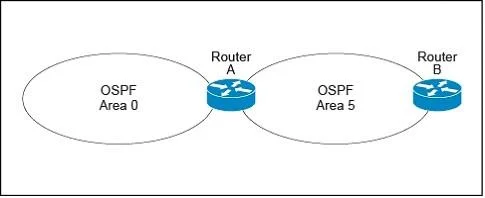
Refer to the exhibit. A customer runs OSPF with Area 5 between its aggregation router and an internal router. When a network change occurs in the backbone, Area 5 starts having connectivity issues…
The correct answer is D. Implement LSA filtering on the ABR, allowing summary routes and preventing more specific. Implementing LSA filtering on the ABR to permit only summary routes into Area 5 reduces LSA flooding and excessive SPF recalculations without requiring stub area support on Router B.
Question
Refer to the exhibit. A customer runs OSPF with Area 5 between its aggregation router and an internal router. When a network change occurs in the backbone, Area 5 starts having connectivity issues due to the SPF algorithm recalculating an abnormal number of times in Area 5. You are tasked to redesign this network to increase resiliency on the customer network with the caveat that Router B does not support the stub area. How can you accomplish this task?
Exhibit
Options
- ASet Area 5 to stubby at the ABR anyway.
- BIncrease the bandwidth on the connection between Router A and Router B.
- CTurn on LSA throttling on all devices in Area 5.
- DImplement LSA filtering on the ABR, allowing summary routes and preventing more specific
- ECreate a virtual link to Area 0 from Router B to the ABR.
How the community answered
(37 responses)- A3% (1)
- B11% (4)
- C5% (2)
- D54% (20)
- E27% (10)
Why each option
Implementing LSA filtering on the ABR to permit only summary routes into Area 5 reduces LSA flooding and excessive SPF recalculations without requiring stub area support on Router B.
OSPF requires all routers within an area to agree on stub area configuration; enabling stub only at the ABR while Router B does not support it would prevent OSPF adjacency formation in Area 5.
Increasing link bandwidth addresses throughput capacity and has no effect on the volume of LSAs entering Area 5 or the frequency of SPF recalculations.
LSA throttling slows the rate at which LSAs are regenerated and flooded but does not prevent external or specific LSAs from entering Area 5 and still triggering SPF runs.
By configuring the ABR to filter outbound Type 3 LSAs - allowing only aggregate summary routes and blocking more-specific and external LSAs from the backbone - Area 5 receives far fewer topology changes, which directly reduces the number of SPF calculations. This approach mimics stub area behavior at the ABR level without requiring any configuration change on Router B. The result is a more resilient Area 5 that is shielded from backbone churn while respecting the hardware limitation.
A virtual link logically extends Area 0 connectivity but does not filter LSAs and would not reduce the number of topology changes propagated into Area 5.
Concept tested: OSPF ABR LSA filtering to limit SPF recalculations in stub-incompatible area
Source: https://www.cisco.com/c/en/us/support/docs/ip/open-shortest-path-first-ospf/200255-OSPF-Area-Filter.html
Topics
Community Discussion
No community discussion yet for this question.