
352-001 · Question #282
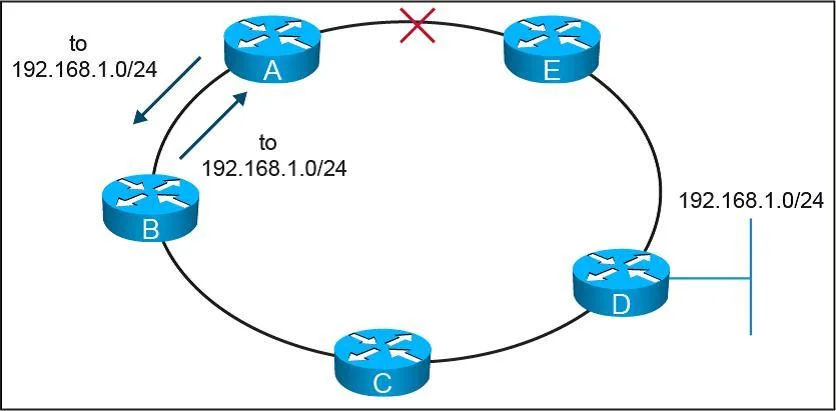
Refer to the exhibit. On this MPLS-based network ring, links have failed between router A and router failures formed microloops while the network converged, when A forwarded traffic to B but B…
The correct answer is D. Remote Loop-Free Alternate. In an MPLS ring topology, Remote Loop-Free Alternate (RLFA) prevents microloops during convergence by tunneling traffic to a remote repair node using LDP, which already runs in the network.
Question
Refer to the exhibit. On this MPLS-based network ring, links have failed between router A and router failures formed microloops while the network converged, when A forwarded traffic to B but B forwards it back to A. Which technology is the simplest solution to avoid microloops without enabling a new protocol in the network?
Exhibit
Options
- ATE Fast ReRoute
- BIP Fast ReRoute
- CLoop-Free Alternate
- DRemote Loop-Free Alternate
How the community answered
(43 responses)- A26% (11)
- B12% (5)
- C5% (2)
- D58% (25)
Why each option
In an MPLS ring topology, Remote Loop-Free Alternate (RLFA) prevents microloops during convergence by tunneling traffic to a remote repair node using LDP, which already runs in the network.
TE Fast ReRoute requires RSVP-TE to signal traffic-engineered LSPs, which is a new signaling protocol and violates the constraint of not enabling a new protocol.
IP Fast ReRoute as a standalone choice refers to basic LFA, which cannot always find a qualifying loop-free adjacent neighbor in a ring topology, leaving certain destinations unprotected.
Standard LFA relies on an adjacent next-hop that satisfies the downstream loop-free condition; in a two-node ring segment, no such neighbor may exist, making LFA insufficient without the remote extension.
RLFA extends standard LFA by using an LDP tunnel to reach a remote P-node that guarantees a loop-free path to the destination. In a ring topology, no adjacent LFA-qualifying neighbor may exist, but RLFA resolves this by leveraging LDP - already present in any MPLS network - to reach a suitable repair node. This avoids microloops without introducing any new protocol such as RSVP-TE.
Concept tested: Remote Loop-Free Alternate microloop avoidance in MPLS rings
Source: https://www.rfc-editor.org/rfc/rfc7490
Topics
Community Discussion
No community discussion yet for this question.