
352-001 · Question #264
Refer to the exhibit. You must ensure that both core A and core B devices have only the minimum information required for reaching the spoke routers yet maintain full reachability during network…
The correct answer is B. Route summarization, with GRE tunnel on hubs A and B. Route summarization minimizes routing table size in the core, while GRE tunnels between hubs provide a backup forwarding path that maintains full reachability during network failures.
Question
Refer to the exhibit. You must ensure that both core A and core B devices have only the minimum information required for reaching the spoke routers yet maintain full reachability during network failures. Which of the following design solutions accomplishes these requirements?
Exhibit
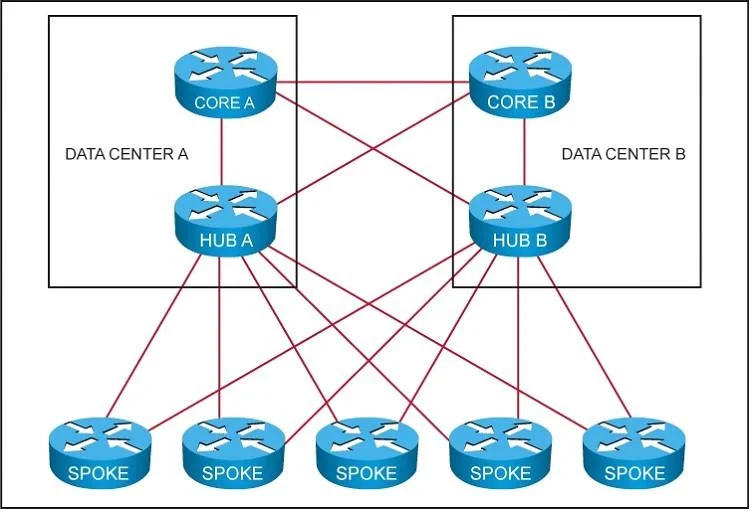
Options
- ARoute summarization, with specific route leaking on hubs A and B
- BRoute summarization, with GRE tunnel on hubs A and B
- CImplement PfR enhancements on hubs A and B
- DImplement ODR for hub-to-spoke routing
How the community answered
(45 responses)- A18% (8)
- B64% (29)
- C11% (5)
- D7% (3)
Why each option
Route summarization minimizes routing table size in the core, while GRE tunnels between hubs provide a backup forwarding path that maintains full reachability during network failures.
Route summarization with specific route leaking reintroduces detailed spoke routes into the core, which directly violates the requirement for minimum routing information on core A and core B.
Route summarization at the hub devices ensures that core A and core B only hold aggregate prefixes rather than every individual spoke route, satisfying the minimum routing information requirement. GRE tunnels between hub A and hub B create a redundant forwarding path so that if one hub loses upstream connectivity, traffic destined for its spoke routers can traverse the inter-hub tunnel and reach the spokes via the other hub, maintaining full reachability during failures.
Performance Routing (PfR) optimizes path selection based on traffic metrics and does not address the goals of minimizing core routing table size or ensuring reachability through a redundant hub path.
On-Demand Routing (ODR) is a simple Cisco-proprietary protocol for hub-and-spoke topologies but does not reduce the routing information visible to the core or guarantee full reachability during hub or link failures.
Concept tested: Route summarization and GRE tunnels for hub-spoke redundancy
Source: https://www.cisco.com/c/en/us/td/docs/ios-xml/ios/iproute_ospf/configuration/xe-16/iro-xe-16-book/iro-cfg.html
Topics
Community Discussion
No community discussion yet for this question.