
352-001 · Question #195
Refer to the exhibit. The network administrator of a large-scale EIGRP network has found that one hub-and-spoke topology in the network is incurring a lot of link flaps. While several attempts have…
The correct answer is B. summarize the routes advertised into the core of the network to reduce the impact of these. Summarizing the unstable hub-and-spoke routes at the boundary prevents individual link flaps from propagating route churn into the core EIGRP domain.
Question
Refer to the exhibit. The network administrator of a large-scale EIGRP network has found that one hub-and-spoke topology in the network is incurring a lot of link flaps. While several attempts have been made to reduce the number of link flaps, it does not appear that the stability of the hub-and-spoke topology can be improved. The reason for this is that most failures seem to result from power outages in a number of locations. Which course of action should the network administrator follow?
Exhibit
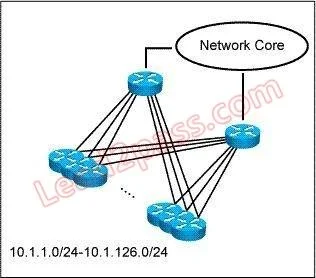
Options
- Aswitch routing protocols to OSPF, then create area boundaries to reduce the size of fault domains
- Bsummarize the routes advertised into the core of the network to reduce the impact of these
- Cdemand that uninterruptible power supplies be installed at every point in the network to prevent
- Dswitch routing protocols to IS-IS, which handles large neighbor counts better and supports Partial
How the community answered
(30 responses)- A10% (3)
- B83% (25)
- C3% (1)
- D3% (1)
Why each option
Summarizing the unstable hub-and-spoke routes at the boundary prevents individual link flaps from propagating route churn into the core EIGRP domain.
Migrating to OSPF and creating area boundaries adds architectural complexity but does not directly limit the flooding impact of the existing link flaps, which would still cause LSA storms within an area.
Route summarization at the hub site boundary causes the core to see only a single stable summary prefix rather than individual spoke prefixes, so when a spoke link flaps the resulting EIGRP query and update traffic is contained within the hub-and-spoke region. This isolation dramatically reduces the size and frequency of topology changes that the rest of the EIGRP domain must process, lowering convergence load without requiring hardware changes or a protocol migration.
Installing UPS equipment is an operational remedy outside the scope of network design and does not address the routing-domain impact of flaps that continue to occur during events the UPS does not cover.
Switching to IS-IS may improve scalability for large neighbor counts but does not suppress the propagation of topology changes caused by power-related link flaps into the broader network.
Concept tested: EIGRP route summarization for fault domain isolation
Source: https://www.cisco.com/c/en/us/td/docs/ios-xml/ios/iproute_eigrp/configuration/xe-16/ire-xe-16-book/ire-route-summ.html
Topics
Community Discussion
No community discussion yet for this question.