
352-001 · Question #127
Refer to the exhibit. On R2 there is a summary route for 192.168.1.0/24 with a next hop of R4. Which change will cause R2 to prefer a path through R1 to reach 192.168.1.0/24?
The correct answer is C. create a virtual link between R1 and R2 and decrease the cost between R1 and R3 to 1. To redirect traffic from R4 to R1, two changes are needed: restore backbone connectivity for R1 via a virtual link, and lower the metric on the R1-R3 segment so that path becomes preferred.
Question
Refer to the exhibit. On R2 there is a summary route for 192.168.1.0/24 with a next hop of R4. Which change will cause R2 to prefer a path through R1 to reach 192.168.1.0/24?
Exhibit
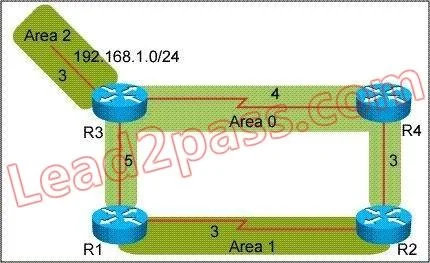
Options
- Aconvert Area 1 to a stub area and decrease the cost between R1 and R3 to 1
- Bcreate a virtual link between R1 and R2
- Ccreate a virtual link between R1 and R2 and decrease the cost between R1 and R3 to 1
- Dchange the link between R1 and R2 to Area 0
How the community answered
(15 responses)- A20% (3)
- B7% (1)
- C67% (10)
- D7% (1)
Why each option
To redirect traffic from R4 to R1, two changes are needed: restore backbone connectivity for R1 via a virtual link, and lower the metric on the R1-R3 segment so that path becomes preferred.
Converting Area 1 to a stub area blocks external LSAs but does not provide backbone connectivity for R1, and a cost change alone without a virtual link still leaves R1 disconnected from the backbone.
A virtual link alone restores backbone reachability but does not change the path metric, so R2 may still prefer R4 if that path has a lower cost.
A virtual link through the backbone is required when R1 lacks direct Area 0 connectivity, because OSPF will not compute intra-area paths across a non-backbone area without it. Decreasing the cost between R1 and R3 to 1 then makes the cumulative metric through R1 lower than the existing path through R4, causing R2 to install the R1 path in its routing table.
Moving the R1-R2 link into Area 0 changes the area topology but does not guarantee a lower metric toward 192.168.1.0/24 than the existing R4 path.
Concept tested: OSPF virtual links and metric tuning for path selection
Source: https://www.cisco.com/c/en/us/support/docs/ip/open-shortest-path-first-ospf/13703-ospf-draft-0.html
Topics
Community Discussion
No community discussion yet for this question.