
350-401 · Question #1240
Lab Simulation 22 Guidelines This is a lab item in which tasks will be performed on virtual devices. - Refer to the Tasks tab to view the tasks for this lab item. - Refer to the Topology tab to…
OSPF DR/BDR Election Lab - Explanation Overall Goal On multi-access networks (like Ethernet), OSPF elects a Designated Router (DR) and Backup Designated Router (BDR) to reduce flooding overhead. The election is based on two criteria, checked in order: 1. Highest OSPF priority…
Question
Exhibits
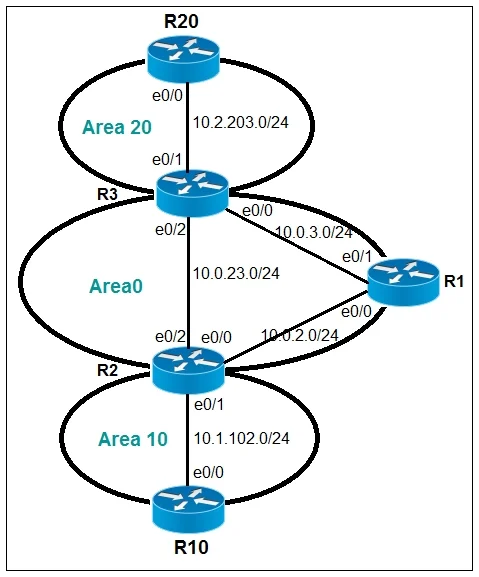
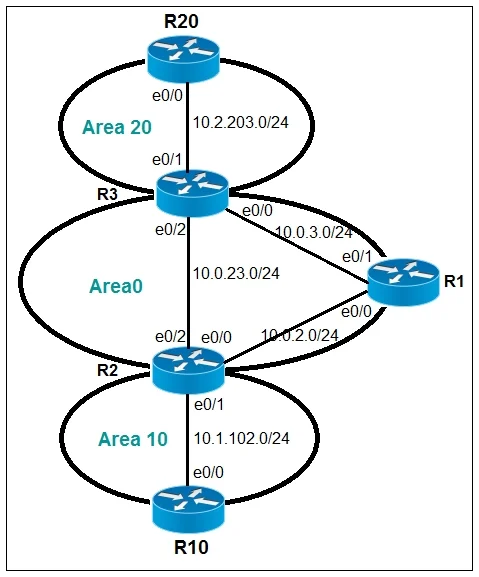
Explanation
OSPF DR/BDR Election Lab - Explanation
Overall Goal
On multi-access networks (like Ethernet), OSPF elects a Designated Router (DR) and Backup Designated Router (BDR) to reduce flooding overhead. The election is based on two criteria, checked in order:
- Highest OSPF priority (range 0-255, default 1)
- Highest Router ID (tiebreaker)
A priority of 0 means "never elect me." A priority of 255 means "elect me above all others."
The lab has two goals:
- Force R20 to always be BDR -> make R3 the DR (highest priority), which pushes R20 to BDR
- Make R10 a DROther (non-participant) -> set its priority to 0
Step-by-Step Reasoning
Step 1 - R3: ip ospf priority 255 on et0/1
Setting R3's priority to 255 guarantees it wins the DR election. Since the DR is elected first, R20 becomes BDR by default (it wins the remaining slot). This indirectly satisfies the "R20 is always BDR" requirement without touching R20 at all.
Why not set R20's priority directly? You could, but making R3 the definitive DR is cleaner and more stable - R20 will always land in the BDR slot as long as R3 is alive.
Step 2 - R10: ip ospf priority 0 on et0/0
Priority 0 disqualifies R10 from the DR/BDR election entirely. It becomes a DROther and only forms adjacencies with the DR and BDR, not with other DROthers.
Why not use
ip ospf network point-to-point? The lab explicitly forbids it. That command bypasses DR/BDR election entirely by changing the network type - it's a heavier-handed approach. Priority 0 achieves the same effect (no participation) while keeping the network type intact.
Step 3 - R20: clear ip ospf process
OSPF DR/BDR elections are non-preemptive - a current DR/BDR holds its role until it fails, even if a higher-priority router appears. Clearing the OSPF process forces a fresh election so the new priorities (from Steps 1 and 2) take effect immediately.
R20 is cleared because it's involved in the election segment and needs to re-run the election with the new configuration in place.
Step 4 - R2: clear ip ospf process
R2 is also on the same multi-access segment (or adjacent segment) and must participate in the re-election. Clearing it ensures all neighbors reconverge cleanly and the new DR/BDR roles are recognized network-wide.
What Goes Wrong If Steps Are Skipped or Reordered
| Skipped Step | Consequence |
|---|---|
| Skip Step 1 | R3 has default priority 1; some other router may win DR, and R20 may not land as BDR |
| Skip Step 2 | R10 still participates in elections and could become DR or BDR unexpectedly |
| Skip Steps 3 & 4 | Priority changes sit dormant; current DR/BDR roles don't change due to non-preemption |
| Clear before configuring | Election runs with old priorities -> wrong result, then you'd need to clear again |
Memory Tip
"255 wins the throne, 0 sits it out, clear to crown."
- 255 -> guaranteed DR (pushes desired router to BDR)
- 0 -> excluded from election
- clear ip ospf process -> triggers the re-election so changes actually apply
Always configure priorities before clearing, or the clear is wasted.
Topics
Community Discussion
No community discussion yet for this question.