
350-401 · Question #1241
Lab Simulation 23 Guidelines This is a lab item in which tasks will be performed on virtual devices. - Refer to the Tasks tab to view the tasks for this lab item. - Refer to the Topology tab to…
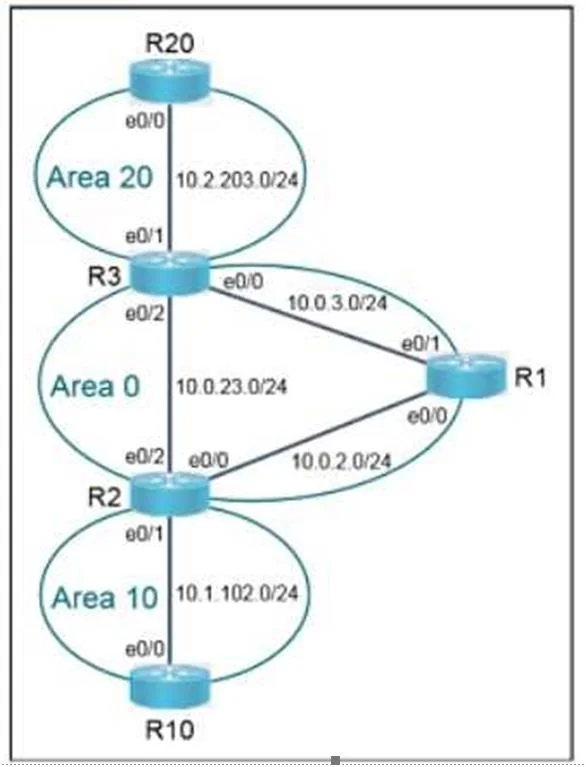
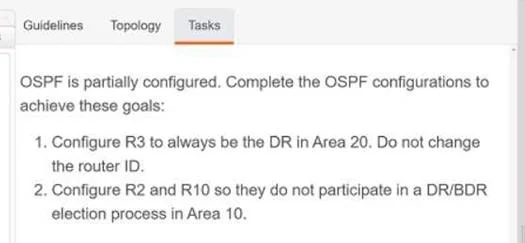
Lab Simulation 23 - OSPF DR/BDR Configuration Explained --- Overall Goal The lab has two distinct OSPF objectives: 1. Area 20 (R3): Force R3 to always win the DR (Designated Router) election. 2. Area 10 (R2, R10): Eliminate the DR/BDR election entirely on the link between R2…
Question
Exhibits
Explanation
Lab Simulation 23 - OSPF DR/BDR Configuration Explained
Overall Goal
The lab has two distinct OSPF objectives:
- Area 20 (R3): Force R3 to always win the DR (Designated Router) election.
- Area 10 (R2, R10): Eliminate the DR/BDR election entirely on the link between R2 and R10.
These are two different solutions to the same underlying problem: controlling unnecessary OSPF overhead on a network.
Background: Why DR/BDR Matters
On multi-access networks (like Ethernet), OSPF elects a Designated Router (DR) and Backup DR (BDR) to reduce LSA flooding. Instead of every router talking to every other router (O(n²) relationships), all routers form adjacencies only with the DR/BDR.
Two ways to control this:
- Influence the election -> raise the OSPF priority (higher = more likely to win)
- Skip the election entirely -> change the network type to point-to-point
Task 1: R3 - Force DR in Area 20
Why this approach?
OSPF priority determines DR election. Default priority is 1. The router with the highest priority wins. Setting priority to 255 (the maximum) guarantees R3 always wins, even if another router joins the segment later with a higher Router ID.
Step-by-step reasoning:
Int e0/1 - You must be in interface configuration mode because OSPF priority is a per-interface setting, not a global one. The interface facing Area 20 is e0/1.
ip ospf priority 255 - Sets priority to the maximum value. Any value > the competitors' priority would win, but 255 is foolproof - no router can outbid it. Priority 0 means "never become DR," so 255 is the opposite extreme.
End - Returns to privileged EXEC mode, required before saving.
copy run start - Saves the running config to NVRAM. Without this, a device reload loses your changes. This is always the final step on each device.
What breaks if skipped?
- Skipping
Int e0/1: The command is applied globally or fails - priority is interface-scoped.- Using priority 1 (default) or 2: Another router with a higher Router ID could win the election.
- Not saving: Config survives until reload, then disappears - you'd lose points.
Task 2: R2 and R10 - Eliminate DR/BDR Election in Area 10
Why this approach?
The link between R2 and R10 in Area 10 is a point-to-point link (only two routers). DR/BDR election is pointless on a two-router link - there's no benefit to electing a DR when there are only two peers. Changing the OSPF network type to point-to-point tells OSPF to skip the election and form a direct full adjacency instead.
This is a cleaner solution than manipulating priorities on a two-router link.
Critical: Both ends of the link must match the network type. If only R2 is changed and R10 is not (or vice versa), the adjacency will fail entirely - they won't be able to form an OSPF neighbor relationship because their Hello packets will have mismatched network type parameters.
R2 steps:
Int e0/1 - The interface on R2 facing the Area 10 link to R10.
ip ospf network point-to-point - Changes the OSPF network type. OSPF will no longer send DR/BDR election Hellos on this interface. It also changes the Hello/Dead timer expectations, so the other end must match.
End + copy run start - Exit and save.
R10 steps (mirror of R2):
Int e0/0 - R10's interface facing R2 (note: different interface number than R2's e0/1 - interface names are local to each device).
ip ospf network point-to-point - Must match R2's setting exactly. Mismatched network types = no adjacency.
End + copy run start - Exit and save.
What breaks if skipped?
- Configuring only one side (R2 but not R10): OSPF adjacency drops. Mismatched network types prevent neighbor formation.
- Using
ip ospf priority 0instead: This prevents that router from becoming DR/BDR, but it doesn't eliminate the election - other routers on the segment still participate. The task says "do not participate," which means eliminating the election, not just opting out.
Why Not Use Priority 0 for Task 2?
priority 0 makes a router ineligible to be DR/BDR, but the election still happens among the remaining routers. Point-to-point network type eliminates the election entirely - which is what "do not participate in a DR/BDR election process" requires.
Memory Tips
| Goal | Command | Mnemonic |
|---|---|---|
| Force DR win | ip ospf priority 255 | "255 = always the boss" |
| Eliminate DR election | ip ospf network point-to-point | "Only two routers? No contest needed" |
| Always save | copy run start | "Run to Start = survive reboot" |
Key rule: Point-to-point network type must be configured on both ends of the link. Think of it like agreeing on a language - if only one side speaks it, communication fails.
Topics
Community Discussion
No community discussion yet for this question.