
350-401 · Question #1239
Lab Simulation 21 Guidelines This is a lab item in which tasks will be performed on virtual devices. - Refer to the Tasks tab to view the tasks for this lab item. - Refer to the Topology tab to…
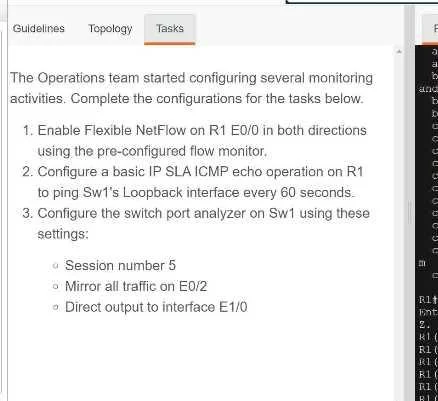
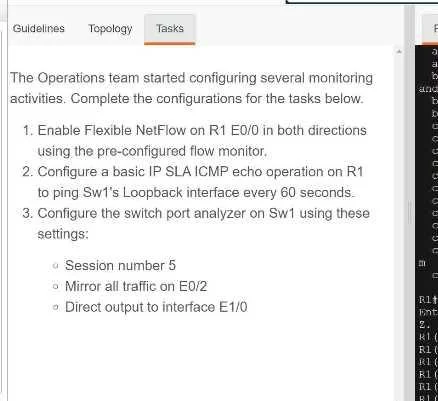
The correct answer demonstrates the proper configuration sequence for three distinct network monitoring technologies: Flexible NetFlow on R1 requires defining a flow exporter with a name and specifying UDP port 2055 as the transport protocol for sending flow data to a…
Question
Lab Simulation 21 Guidelines This is a lab item in which tasks will be performed on virtual devices.
- Refer to the Tasks tab to view the tasks for this lab item.
- Refer to the Topology tab to access the device console(s) and perform the tasks.
- Console access is available for all required devices by clicking the device icon or using the
tab(s) above the console window.
- All necessary preconfigurations have been applied.
- Do not change the enable password or hostname for any device.
- Save your configurations to NVRAM before moving to the next item.
- Click Next at the bottom of the screen to submit this lab and move to the next question.
- When Next is clicked, the lab closes and cannot be reopened.
Topology Tasks Answer:
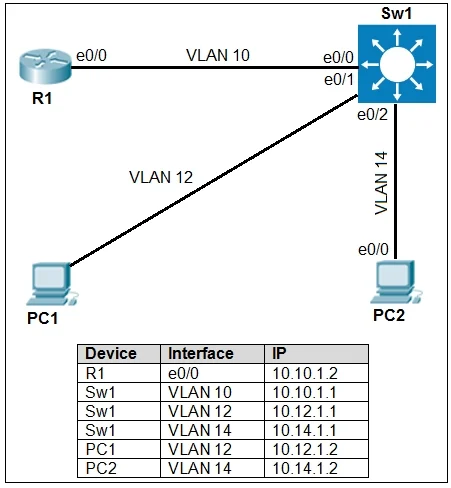
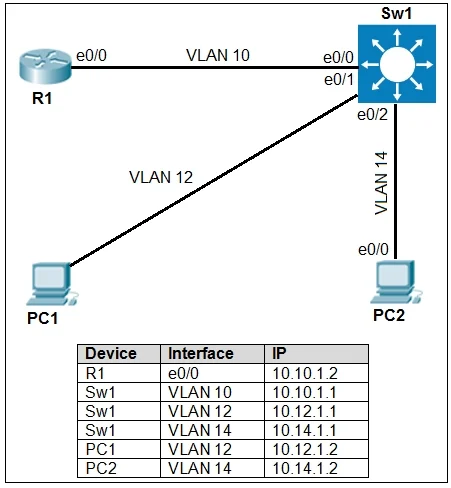
R1 config flow exporter Export-NetFlowENCOR transport udp 2055 ip sla schedule 100 life forever start-time now wr Sw1 monitor session 11 source interface e0/2 monitor session 11 destination interface et1/1 wr
Exhibits
Explanation
The correct answer demonstrates the proper configuration sequence for three distinct network monitoring technologies: Flexible NetFlow on R1 requires defining a flow exporter with a name and specifying UDP port 2055 as the transport protocol for sending flow data to a collector; the IP SLA schedule command activates the pre-configured ICMP echo operation (100) to run indefinitely starting immediately; and the SPAN (Switch Port Analyzer) session on Sw1 correctly maps a source interface (e0/2) to a destination interface (et1/1) for traffic mirroring. Each 'wr' (write memory) command ensures configurations are saved to NVRAM as required by the lab guidelines.
Topics
Community Discussion
No community discussion yet for this question.