
350-401 · Question #383
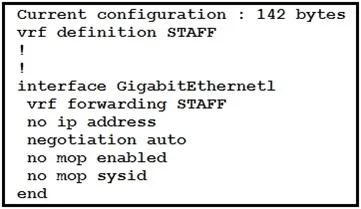
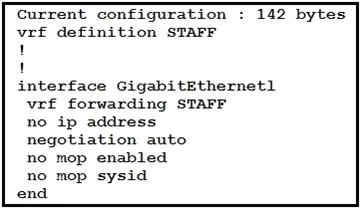
Refer to the exhibit. An engineer must assign an IP address of 192.168.1.1/24 to the GigabitEthemet1 interface. Which two commands must be added to the existing configuration to accomplish this…
The correct answer is B. Router(config-if)# ip address 192.168.1.1 255.255.255.0 E. Router(config-vrf)# address-family ipv4. Explanation When configuring an IP address on an interface that is associated with a VRF (Virtual Routing and Forwarding) instance, two steps are required: first, the VRF must have IPv4 address-family enabled using address-family ipv4 at the VRF configuration level (Option E)…
Question
Refer to the exhibit. An engineer must assign an IP address of 192.168.1.1/24 to the GigabitEthemet1 interface. Which two commands must be added to the existing configuration to accomplish this task? (Choose two)
Exhibits
Options
- ARouter(config-vrf)# address-family ipv6
- BRouter(config-if)# ip address 192.168.1.1 255.255.255.0
- CRouter(config-vrf)# ip address 192.168.1.1 255.255.255.0
- DRouter(config-if)# address-family ipv4
- ERouter(config-vrf)# address-family ipv4
How the community answered
(23 responses)- A4% (1)
- B74% (17)
- C9% (2)
- D13% (3)
Explanation
Explanation
When configuring an IP address on an interface that is associated with a VRF (Virtual Routing and Forwarding) instance, two steps are required: first, the VRF must have IPv4 address-family enabled using address-family ipv4 at the VRF configuration level (Option E), and then the IP address is applied directly on the interface using ip address 192.168.1.1 255.255.255.0 (Option B). Without enabling the IPv4 address-family in the VRF, the interface cannot properly associate its IP address with that VRF routing table.
Why distractors are wrong:
- Option A (
address-family ipv6) is incorrect because we are assigning an IPv4 address, not IPv6 - Option C is wrong because IP addresses are never assigned at the VRF config level - they must be assigned under the interface
- Option D is wrong because
address-family ipv4is a VRF-level command, not an interface-level command; interfaces useip addresssyntax
Memory Tip
Think of it as a two-layer sandwich: the VRF layer must be "activated" for IPv4 first (address-family ipv4 in config-vrf), and then the interface layer gets the actual IP address. Each command belongs to its own configuration context - never mix them up!
Topics
Community Discussion
No community discussion yet for this question.