
350-001 · Question #168
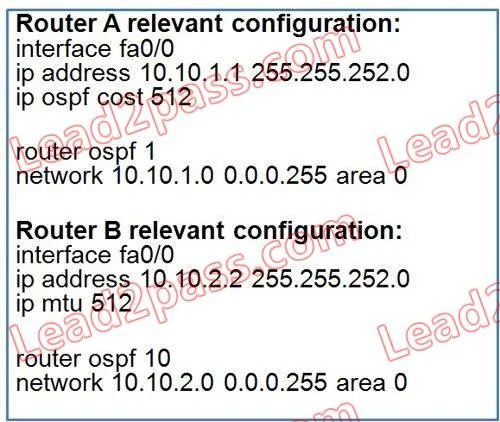
Refer to the exhibit. Routers A and B are directly connected and running OSPF, but they are unable to form a neighbor relationship. What is the most likely cause?
The correct answer is D. The MTU does not match. OSPF sends the interface MTU in a database description packet. If there is a MTU mismatch, OSPF will not form an adjacency and they are stuck in exstart/exchange state. The interface MTU option was added in RFC 2178. Previously, there was no mechanism to detect the interface…
Question
Refer to the exhibit. Routers A and B are directly connected and running OSPF, but they are unable to form a neighbor relationship. What is the most likely cause?
Exhibit
Options
- AThe routers are not on the same network.
- BThe network statements do not match.
- CThe process number does not match.
- DThe MTU does not match.
- EThe OSPF cost does not match.
- FThere is a physical issue with the cable.
How the community answered
(29 responses)- A3% (1)
- D76% (22)
- E7% (2)
- F14% (4)
Explanation
OSPF sends the interface MTU in a database description packet. If there is a MTU mismatch, OSPF will not form an adjacency and they are stuck in exstart/exchange state. The interface MTU option was added in RFC 2178. Previously, there was no mechanism to detect the interface MTU mismatch. This option was added in Cisco IOS Software Release 12.0.3 and later. If the router with the higher MTU sends a packet larger that the MTU set on the neighboring router, the neighboring router ignores the packet and the neighbor state remains in exstart. Note: By default, the MTU for Ethernet is 1500 bytes. We can check the OSPF adjacency process with the command "show ip ospf neighbor".
Topics
Community Discussion
No community discussion yet for this question.