
350-001 · Question #83
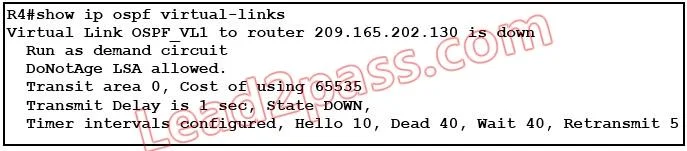
Refer to the exhibit. An OSPF virtual link is configured between R4 and R3. Based upon the show command output, why is the virtual-link down?
The correct answer is A. Virtual links cannot transit area 0. OSPF virtual links must transit a non-backbone area; configuring a virtual link through area 0 is invalid and causes it to remain down.
Question
Refer to the exhibit. An OSPF virtual link is configured between R4 and R3. Based upon the show command output, why is the virtual-link down?
Exhibit
Options
- AVirtual links cannot transit area 0.
- BThe cost of the virtual link needs to be configured as 1.
- CThe timer intervals for virtual links need to be aggressive (2, 8, 8, and 1).
- DThe virtual interface VL1 is shut down.
How the community answered
(50 responses)- A82% (41)
- B6% (3)
- C2% (1)
- D10% (5)
Why each option
OSPF virtual links must transit a non-backbone area; configuring a virtual link through area 0 is invalid and causes it to remain down.
An OSPF virtual link is used to logically connect a discontiguous area to the backbone by transiting an intermediate non-backbone area. Area 0 (the backbone) cannot serve as the transit area for a virtual link because the virtual link itself is meant to extend or reconnect to area 0, making it a logical contradiction that OSPF will reject.
Virtual link cost is derived from the intra-area path cost of the transit area and does not need to be manually set to 1 for the link to come up.
Aggressive timer values are not a requirement for virtual links to become operational; default timers are acceptable.
OSPF virtual link interfaces (VL interfaces) come up automatically when properly configured and cannot be manually shut down like physical interfaces.
Concept tested: OSPF virtual link transit area requirements
Source: https://www.cisco.com/c/en/us/support/docs/ip/open-shortest-path-first-ospf/13703-8.html
Topics
Community Discussion
No community discussion yet for this question.