
350-001 · Question #194
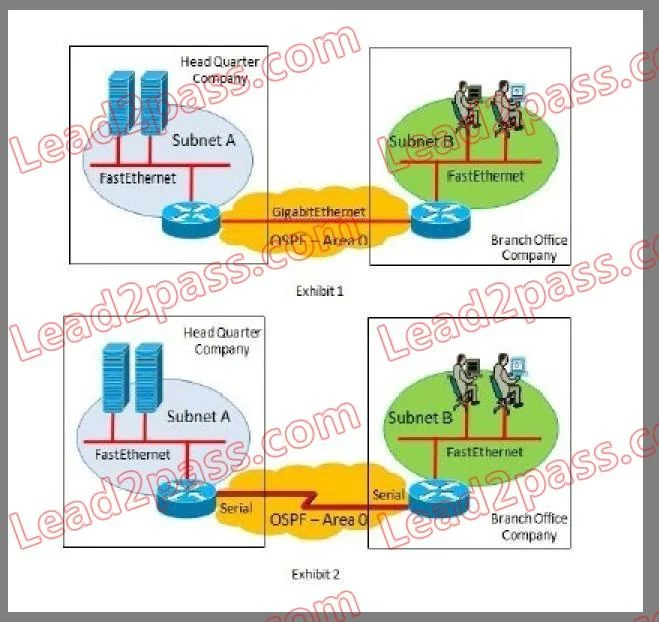
Refer to exhibits 1 and 2. A company uses a Metro Ethernet (Gigabit Ethernet) dedicated circuit to communicate between users (subnet B) and servers (subnet A) as shown in Exhibit 1. Both routers use…
The correct answer is D. Use OSPF network point-to-multipoint nonbroadcast, because it establishes a neighbor. OSPF Point-to-Multipoint Network with Separate Costs per Neighbor Description OSPF has two new features related to point-to-multipoint networks. One feature applies to broadcast networks; the other feature applies to nonbroadcast networks. On point-to-multipoint, broadcast…
Question
Refer to exhibits 1 and 2. A company uses a Metro Ethernet (Gigabit Ethernet) dedicated circuit to communicate between users (subnet B) and servers (subnet A) as shown in Exhibit 1. Both routers use OSPF to advertise the subnets. During a weekly management meeting, they realize that the WAN link is oversize. They have been using only 2 Mb/s in the worst-case scenario. So they propose a new, cheaper WAN connection using a 2-Mb/s Frame-Relay point-to-point link to interconnect both sites (Exhibit 2). The Frame Relay service provider informs them that multicast traffic is not allowed to run over the service provider network. Which one of these options is best to enable the company to establish the OSPF neighbor adjacency?
Exhibit
Options
- AUse OSPF network broadcast, because it uses unicast to establish a neighbor relationship.
- BUse OSPF network point-to-multipoint, because it uses unicast to establish a neighbor
- CUse OSPF network point-to-point, because it uses unicast to establish a neighbor relationship.
- DUse OSPF network point-to-multipoint nonbroadcast, because it establishes a neighbor
- EUse OSPF network nonbroadcast, because it establishes a neighbor relationship using multicast.
How the community answered
(43 responses)- A5% (2)
- B2% (1)
- C19% (8)
- D67% (29)
- E7% (3)
Explanation
OSPF Point-to-Multipoint Network with Separate Costs per Neighbor Description OSPF has two new features related to point-to-multipoint networks. One feature applies to broadcast networks; the other feature applies to nonbroadcast networks. On point-to-multipoint, broadcast networks, there is no need to specify neighbors. However, you can specify neighbors with the neighbor command, in which case you should specify a cost to that neighbor. On point to multipoint, nonbroadcast networks, you now use the neighbor command to identify Assigning a cost to a neighbor is optional. Before this feature, some OSPF point-to-multipoint protocol traffic was treated as multicast traffic. Therefore, the neighbor command was not needed for point-to-multipoint interfaces because multicast took care of the traffic. Hellos, updates and acknowledgments were sent using multicast. In particular, multicast hellos discovered all neighbors dynamically. However, some customers were using point-to-multipoint on nonbroadcast media (such as classic IP over ATM), so their routers could not dynamically discover their neighbors. This feature allows the neighbor command to be used on point-to-multipoint interfaces. On any point-to-multipoint interface (broadcast or not), the Cisco IOS software assumed the cost to each neighbor was equal. The cost was configured with the ip ospf cost command. In reality, the bandwidth to each neighbor is different, so the cost should be different. With this feature, you can configure a separate cost to each neighbor. This feature applies to point-to-multipoint interfaces only. You can now configure neighbors on point-to-multipoint interfaces and assign a cost to each neighbor. These capabilities allow the router to dynamically discover neighbors over nonbroadcast media and to prefer some routes over others by assigning different costs to
Topics
Community Discussion
No community discussion yet for this question.