
350-001 · Question #200
Refer to the exhibit. In this network, what will be the impact at R4 if the link between R1 and R2 fails?
The correct answer is B. R4 will not receive any new LSAs of any type, nor will it run SPF. This question tests understanding of OSPF area types and LSA propagation boundaries. Based on the network topology in the exhibit, R4 resides in a totally stubby area. In a totally stubby area, the ABR blocks Type 3 (Summary), Type 4 (ASBR Summary), and Type 5 (AS External)…
Question
Refer to the exhibit. In this network, what will be the impact at R4 if the link between R1 and R2 fails?
Exhibit
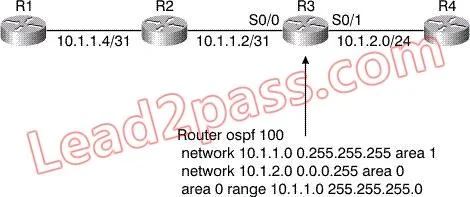
Options
- AR3 will generate a new summary (type 3) LSA when the link between R1 and R2 fails. When
- BR4 will not receive any new LSAs of any type, nor will it run SPF.
- CR4 will receive a router (type 1) LSA from R2, since it has lost its connection to R2. When R4
- DR2 will generate a new network (type 2) LSA, since it has lost its connection to 10.1.1.4/30.
How the community answered
(58 responses)- A9% (5)
- B53% (31)
- C26% (15)
- D12% (7)
Explanation
This question tests understanding of OSPF area types and LSA propagation boundaries. Based on the network topology in the exhibit, R4 resides in a totally stubby area. In a totally stubby area, the ABR blocks Type 3 (Summary), Type 4 (ASBR Summary), and Type 5 (AS External) LSAs from entering the area, sending only a single default route Type 3 LSA instead. When the link between R1 and R2 fails, new Type 1 or Type 2 LSAs are generated within the backbone (Area 0), but these intra-area LSAs for Area 0 never propagate into R4's stub area. Since the ABR's summary or default route to R4's area does not change as a result of this specific link failure, R4 receives no new LSAs of any type and therefore has no trigger to run the SPF algorithm - its routing table remains unchanged.
Topics
Community Discussion
No community discussion yet for this question.