
350-001 · Question #199
Refer to the exhibit. A network engineer has connected a packet-capturing device to the common broadcast segment in this network, on which all the routers are configured to run OSPF. By examining…
The correct answer is A. This is correct operation; flooding new LSA information to the other routers is a function of the. This describes correct and expected OSPF DR (Designated Router) behavior on a broadcast multi-access segment. When a non-DR router (R3) originates or receives a new LSA, it sends it to the multicast address 224.0.0.6 (AllDRRouters), which only the DR and BDR receive. The DR…
Question
Refer to the exhibit. A network engineer has connected a packet-capturing device to the common broadcast segment in this network, on which all the routers are configured to run OSPF. By examining various show commands on the routers, the engineer discovers that the designated router is R1. By examining the captured packets, the engineer also discovers that every new LSA that R3 sends to the link, R1 resends to the link a few moments later. Is this correct OSPF operation, and why or why not?
Exhibit
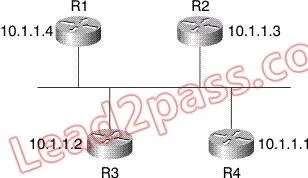
Options
- AThis is correct operation; flooding new LSA information to the other routers is a function of the
- BThis is incorrect operation; each new LSA should only be flooded onto a given broadcast link
- CThis is correct operation; OSPF uses a scheme whereby each LSA flooded onto a link is
- DThis is incorrect operation; it indicates that while R3 can send packets to R1, R1 cannot send
How the community answered
(41 responses)- A80% (33)
- B7% (3)
- C2% (1)
- D10% (4)
Explanation
This describes correct and expected OSPF DR (Designated Router) behavior on a broadcast multi-access segment. When a non-DR router (R3) originates or receives a new LSA, it sends it to the multicast address 224.0.0.6 (AllDRRouters), which only the DR and BDR receive. The DR (R1) then re-floods that LSA to 224.0.0.5 (AllSPFRouters) so all routers on the segment receive it. This two-step flooding mechanism is why the DR exists - it reduces flooding overhead by acting as the central redistribution point for LSAs on the broadcast segment. Without the DR, every router would have to send LSAs directly to every other router (O(n²) flooding). R1 re-sending R3's LSA a few moments later is precisely the DR fulfilling its designated role.
Topics
Community Discussion
No community discussion yet for this question.