
350-001 · Question #167
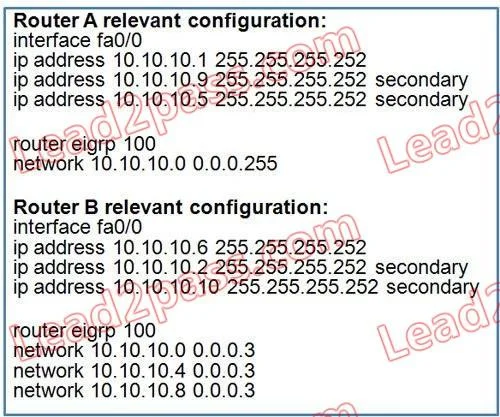
Refer to the exhibit. Routers A and B are directly connected and running EIGRP, but they are unable to form a neighbor relationship. What is the most likely cause?
The correct answer is B. The IP address statements are misconfigured. To form neighbor relationship in EIGRP, these conditions must be met: Pass the authentication process Have the same con figured AS number Must believe that the source IP address of a received Hello is in that router's primary connected subnet on that interface The third item…
Question
Refer to the exhibit. Routers A and B are directly connected and running EIGRP, but they are unable to form a neighbor relationship. What is the most likely cause?
Exhibit
Options
- AThe network statements are misconfigured.
- BThe IP address statements are misconfigured.
- CThe autonomous system is misconfigured.
- DThere is a physical issue with the cable.
How the community answered
(19 responses)- A5% (1)
- B79% (15)
- C5% (1)
- D11% (2)
Explanation
To form neighbor relationship in EIGRP, these conditions must be met: Pass the authentication process Have the same con figured AS number Must believe that the source IP address of a received Hello is in that router's primary connected subnet on that interface The third item means that the primary ip address of the neighbor must be in the same subnet with the primary ip address of the received interface. But in this case the primary ip address of router A is 10.10.10.1/30 and it is not in the same subnet with the primary ip address of router B 10.10.10.6/30 -> no EIGRP neighbor relationship is formed.
Topics
Community Discussion
No community discussion yet for this question.