
300-920 · Question #28
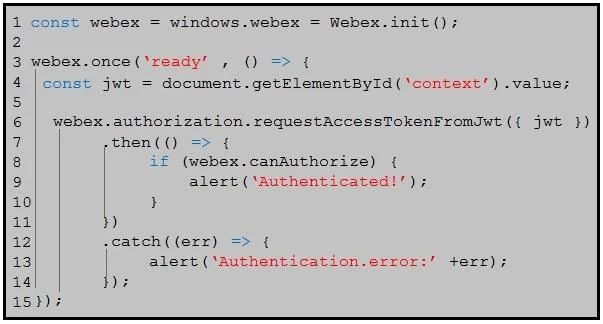
Refer to the exhibit. On line 4, the script retrieves a context from a DOM element that was generated from a server-side component. How does that server-side component obtain the value for the…
The correct answer is B. by completing an authorization code grant flow using the identifier and secret of an OAuth. Option B is correct because the authorization code grant flow is the standard OAuth 2.0 server-side authentication pattern: the server uses its OAuth application's client identifier and secret to exchange an authorization code (obtained after a user authorizes the app) for an…
Question
Exhibit
Options
- Aby opening a dialog asking the end-user to paste his personal access token
- Bby completing an authorization code grant flow using the identifier and secret of an OAuth
- Cby embedding the access token of a Bot account
- Dby creating a guest token using the identifier and secret of a Guest Issuer application
How the community answered
(39 responses)- A3% (1)
- B82% (32)
- C10% (4)
- D5% (2)
Explanation
Option B is correct because the authorization code grant flow is the standard OAuth 2.0 server-side authentication pattern: the server uses its OAuth application's client identifier and secret to exchange an authorization code (obtained after a user authorizes the app) for an access token. That token is then embedded into the server-rendered HTML DOM so the client-side script can retrieve it on line 4.
Why the distractors are wrong:
- A is wrong because a server-side component renders automatically - it does not open dialogs or rely on a user to manually paste anything. That would be a client-side, manual flow.
- C is wrong because Bot account tokens authenticate a bot acting on its own behalf, not on behalf of a human user. Embedding a Bot token would grant bot-level access, not user-delegated access, which is inappropriate for this pattern.
- D is wrong because Guest Issuer tokens are designed to onboard temporary, non-authenticated guest users (people without accounts on the platform). This serves a different use case than authenticating a real user.
Memory tip: Think "Server = Secret." Only the authorization code grant flow (B) involves the server securely using a secret to exchange for a token on the back channel - keeping credentials out of the browser. If it involves a secret, it belongs on the server; if it involves a guest or a bot, it's for a different actor entirely.
Topics
Community Discussion
No community discussion yet for this question.