
300-920 · Question #29
Refer to the exhibit. What causes the error message?
The correct answer is B. HttpClient AllowInsecureHTTPS has not been enabled. Option B is correct because the error shown is a TLS/SSL certificate verification failure - the HttpClient is attempting an HTTPS connection but rejecting the server's certificate (likely self-signed or untrusted). In Cisco's macro/scripting environment, HttpClient requires…
Question
Exhibit
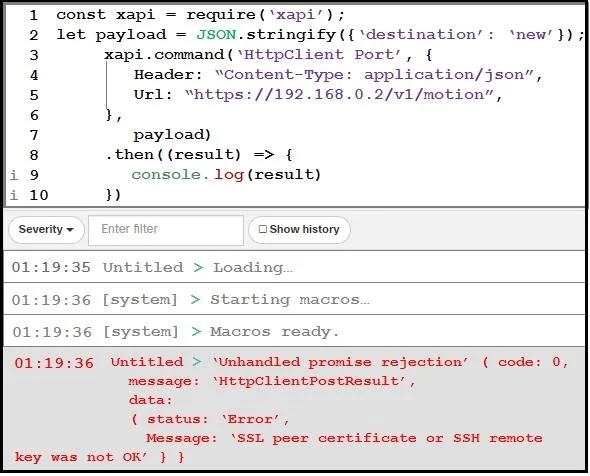
Options
- Axapi must be enabled for promises.
- BHttpClient AllowInsecureHTTPS has not been enabled.
- CThe NODE_TLS_REJECT_UNAUTHORIZED environment variable must be set to 0.
- DHttpClient must be changes to HttpsClient.
How the community answered
(46 responses)- A7% (3)
- B50% (23)
- C28% (13)
- D15% (7)
Explanation
Option B is correct because the error shown is a TLS/SSL certificate verification failure - the HttpClient is attempting an HTTPS connection but rejecting the server's certificate (likely self-signed or untrusted). In Cisco's macro/scripting environment, HttpClient requires AllowInsecureHTTPS to be explicitly enabled before it will accept connections to servers without a trusted certificate.
Why the distractors are wrong:
- A is wrong because xAPI enabling relates to device API access, not TLS certificate handling.
- C is wrong because
NODE_TLS_REJECT_UNAUTHORIZED=0is a Node.js environment variable - it doesn't apply to the Cisco macro runtime'sHttpClient. - D is wrong because
HttpClientalready handles HTTPS; switching to a different class name doesn't exist or resolve certificate trust issues.
Memory tip: Think of AllowInsecureHTTPS as a deliberate "I accept the risk" flag - the client blocks untrusted HTTPS by default for security, so you must explicitly opt in to allow it. If you see a TLS/certificate error in a Cisco macro script, your first check is whether that flag is set.
Topics
Community Discussion
No community discussion yet for this question.