
300-920 · Question #55
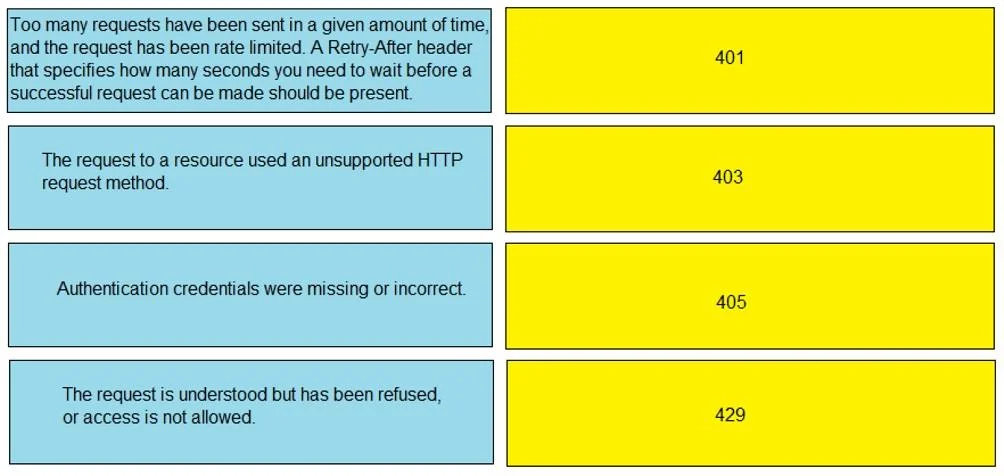
Drag and Drop Question Drag and drop the definitions from the left onto the correct Webex Teams REST API HTTP response status codes on the right. Answer:
The correct answer is Authentication credentials were missing or incorrect.; The request is understood but has been refused, or access is not allowed.; The request to a resource used an unsupported HTTP request method; Too many requests have been sent in a given amount of time, and the request has been rate limited. A Retry-After header that specifies how many seconds you need to wait before a successful request can be made should be present. The question requires matching specific definitions related to client-side HTTP errors to their corresponding HTTP status codes, testing knowledge of common 4xx response codes.
Question
Exhibit
Answer Area
Drag items
Correct arrangement
- Authentication credentials were missing or incorrect.
- The request is understood but has been refused, or access is not allowed.
- The request to a resource used an unsupported HTTP request method
- Too many requests have been sent in a given amount of time, and the request has been rate limited. A Retry-After header that specifies how many seconds you need to wait before a successful request can be made should be present.
Explanation
The question requires matching specific definitions related to client-side HTTP errors to their corresponding HTTP status codes, testing knowledge of common 4xx response codes.
Approach. The correct approach is to drag each definition to its accurate HTTP status code based on standard HTTP protocol definitions:
-
Drag 'Too many requests have been sent in a given amount of time, and the request has been rate limited. A Retry-After header that specifies how many seconds you need to wait before a successful request can be made should be present.' to 429.
- Reasoning: HTTP status code 429 'Too Many Requests' is specifically used when a user has sent too many requests in a given amount of time (rate limiting). The mention of 'Retry-After' header further confirms this, as it's a common practice with 429 responses.
-
Drag 'The request to a resource used an unsupported HTTP request method.' to 405.
- Reasoning: HTTP status code 405 'Method Not Allowed' indicates that the HTTP method (e.g., GET, POST, PUT, DELETE) used in the request is not supported for the resource identified by the Request-URI.
-
Drag 'Authentication credentials were missing or incorrect.' to 401.
- Reasoning: HTTP status code 401 'Unauthorized' indicates that the client must authenticate itself to get the requested response. This usually means missing or invalid authentication credentials (like an API key or token).
-
Drag 'The request is understood but has been refused, or access is not allowed.' to 403.
- Reasoning: HTTP status code 403 'Forbidden' indicates that the server understands the request but refuses to authorize it. Unlike 401, authentication has already occurred (or is not applicable), but the authenticated user does not have permission to access the resource.
Common mistakes.
- common_mistake. A common mistake is confusing 401 (Unauthorized) with 403 (Forbidden). While both relate to access issues, 401 means 'authentication required or failed' (you haven't proven who you are, or your proof is invalid), whereas 403 means 'authorization denied' (the server knows who you are, but you don't have permission to perform that action or access that resource). Misunderstanding the distinction between authentication (proving identity) and authorization (proving permission) leads to incorrect matching. Another potential error could be misattributing rate limiting to a generic server error (5xx) or a different client error, rather than the specific 429 status code.
Concept tested. Understanding of common HTTP client error (4xx) status codes, specifically 401 Unauthorized, 403 Forbidden, 405 Method Not Allowed, and 429 Too Many Requests, and their associated meanings in API communication.
Topics
Community Discussion
No community discussion yet for this question.