
300-515 · Question #91
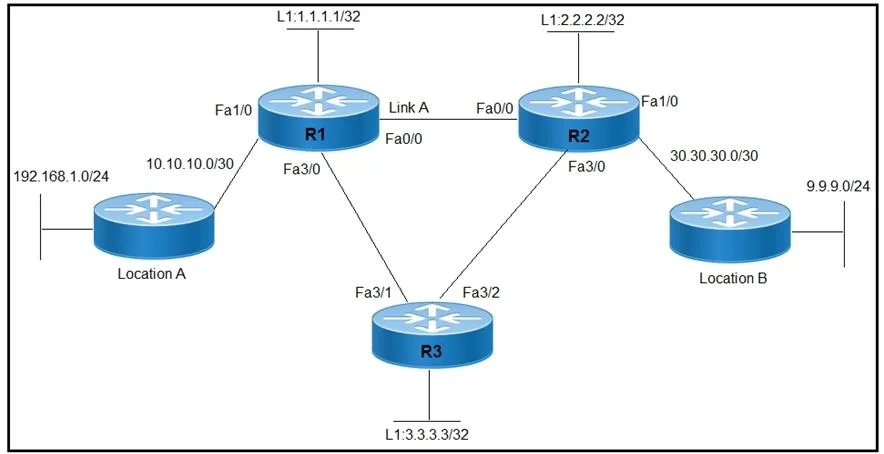
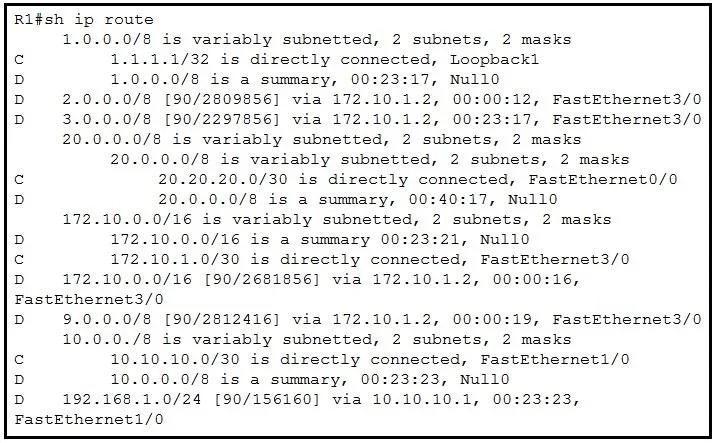
Refer to the exhibit. IPv4 traffic between location A and location B has previously experienced no congestion or packet drops. The hub R3 router was recently added to the network and connected to R1…
The correct answer is A. Configure the fa3/0 interfaces on R1 and R2 as passive interfaces. By making the Frame-Relay interfaces toward R3 passive in OSPF, you prevent R1 and R2 from forming adjacencies with R3. That removes R3 as an alternate transit path, so when the direct Link A fails, traffic does not try to loop through R3 (and saturate the T1 links).
Question
Refer to the exhibit. IPv4 traffic between location A and location B has previously experienced no congestion or packet drops. The hub R3 router was recently added to the network and connected to R1 and R2 over Frame Relay T1. Link A has just gone down, and an engineer is observing congestion on both of the R3 connected links. Which change must the engineer make to the network topology to fix the issue and prevent such congestion if link A goes down again?
Exhibits
Options
- AConfigure the fa3/0 interfaces on R1 and R2 as passive interfaces.
- BConfigure R1 and R2 as stub routers.
- CConfigure R3 as a stub router.
- DConfigure the fa3/0 interface on R1 as a passive interface.
How the community answered
(22 responses)- A77% (17)
- B5% (1)
- C14% (3)
- D5% (1)
Explanation
By making the Frame-Relay interfaces toward R3 passive in OSPF, you prevent R1 and R2 from forming adjacencies with R3. That removes R3 as an alternate transit path, so when the direct Link A fails, traffic does not try to loop through R3 (and saturate the T1 links).
Topics
Community Discussion
No community discussion yet for this question.