
300-515 · Question #87
Refer to the exhibit. A network engineer is implementing an OSPF configuration. Based on the output, which statement is true?
The correct answer is B. OSPFv3 does not run for IPv4 on FastEthemet0/0 until IPv6 routing is enabled on the router. Option B is correct because OSPFv3 uses IPv6 link-local addresses for all neighbor discovery and hello packet exchanges, regardless of whether it's carrying IPv4 or IPv6 routing information. This means even when OSPFv3 is configured with an IPv4 address family (per RFC 5838)…
Question
Refer to the exhibit. A network engineer is implementing an OSPF configuration. Based on the output, which statement is true?
Exhibit
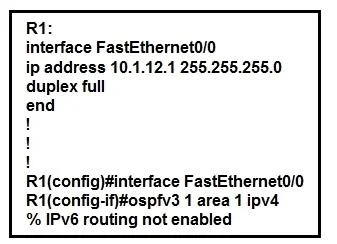
Options
- AIn the ospfv3 1 area 1 ipv4 command, area 0 must be configured instead of area 1.
- BOSPFv3 does not run for IPv4 on FastEthemet0/0 until IPv6 routing is enabled on the router
- COSPFv3 cannot be configured for IPv4; OSPFv3 works only for IPv6.
- DIPv6 routing not enabled is just an informational message and OSPFv3 runs for IPv4 on
How the community answered
(31 responses)- A3% (1)
- B84% (26)
- C3% (1)
- D10% (3)
Explanation
Option B is correct because OSPFv3 uses IPv6 link-local addresses for all neighbor discovery and hello packet exchanges, regardless of whether it's carrying IPv4 or IPv6 routing information. This means even when OSPFv3 is configured with an IPv4 address family (per RFC 5838), the underlying transport still depends on IPv6 being active - so without ipv6 unicast-routing enabled, OSPFv3 simply will not form adjacencies on that interface.
Why the distractors are wrong:
- A is wrong because OSPF area numbering is a design choice - non-backbone areas (area 1, 2, etc.) are perfectly valid; there's no rule forcing area 0 here.
- C is wrong because OSPFv3 can support IPv4 via address families (RFC 5838 extension), so the claim that it's IPv6-only is factually incorrect.
- D is wrong because that message is not merely informational - it is an error condition that actively prevents OSPFv3 from operating on the interface until IPv6 routing is enabled.
Memory tip: Think of OSPFv3 as a car that runs on IPv6 fuel - it can carry IPv4 cargo (address families), but it still needs IPv6 in the tank to start the engine at all.
Topics
Community Discussion
No community discussion yet for this question.