
300-515 · Question #176
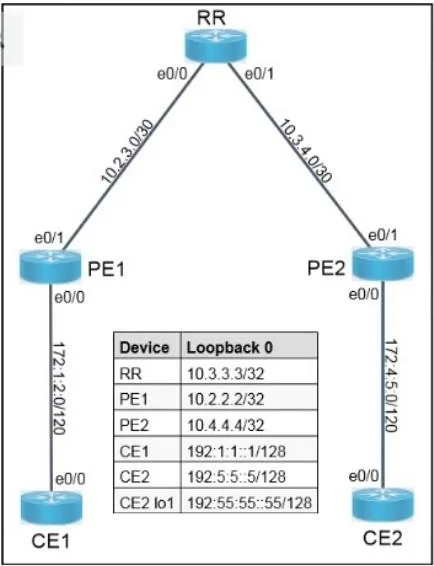
SIMULATION 6 Guidelines This is a lab item in which tasks will be performed on virtual devices. Refer to the Tasks tab to view the tasks for this lab item Refer to the Topology tab to access the…
The correct answer is C. Apply route-map vlan10_to_ISP_2 on RA Ge2/1. There is an important mismatch to flag here: the simulation describes an MPLS L3VPN/IPv6 BGP lab (CE, PE, RR topology), but the answer choices reference a route-map on router "RA" with interfaces like Ge1/10, Ge2/0, Ge2/1, and Ge1/20. These choices appear to belong to a…
Question
Exhibits
Options
- AApply route-map vlan10_to_ISP_2 on RA Ge1/10.
- BApply route-map vlan10_to_ISP_2 on RA Ge2/0.
- CApply route-map vlan10_to_ISP_2 on RA Ge2/1.
- DApply route-map vlan10_to_ISP_2 on RA Ge1/20.
How the community answered
(57 responses)- A12% (7)
- B23% (13)
- C58% (33)
- D7% (4)
Explanation
There is an important mismatch to flag here: the simulation describes an MPLS L3VPN/IPv6 BGP lab (CE, PE, RR topology), but the answer choices reference a route-map on router "RA" with interfaces like Ge1/10, Ge2/0, Ge2/1, and Ge1/20. These choices appear to belong to a different question that has been paired with this simulation description, which is a known formatting issue in some Cisco exam banks.
Taking the choices at face value: the route-map name vlan10_to_ISP_2 signals that it controls routes from VLAN 10 outbound toward ISP 2. In a typical dual-ISP topology, Ge2/1 is the interface facing ISP 2, making it the correct outbound policy application point - applying it there ensures the route-map filters/manipulates only the traffic destined for that specific upstream neighbor.
- A (Ge1/10) is wrong because Ge1/x interfaces typically face the LAN or internal VLANs, not an ISP uplink.
- B (Ge2/0) is likely the ISP 1 uplink - wrong ISP, wrong interface for a policy named
_ISP_2. - D (Ge1/20) is another LAN-side interface, not an upstream ISP link.
Memory tip: Match the route-map name to the interface - if the policy says _ISP_2, it belongs on the interface facing ISP 2. The Ge2/x range signals WAN/uplink in most exam topologies; Ge1/x signals LAN/access.
Topics
Community Discussion
No community discussion yet for this question.