
300-515 · Question #90
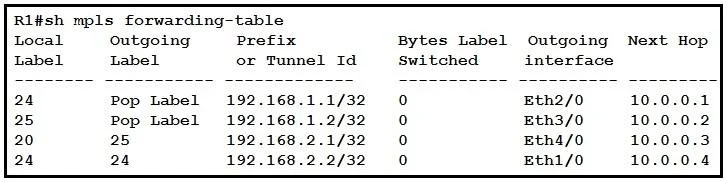
Refer to the exhibit. Edge router R1 is installed at a Tier 1 ISP using OSPF with TE extensions in area 0 as an underlayer routing protocol. The tunnel is configured with explicit path-option path1…
The correct answer is B. Configure mpls traffic-eng area 0 under the OSPF configuration. After the reload the router was no longer advertising or learning OSPF-TE link state, so the explicit‐path-protect LSP had no TE topology to use. Enabling mpls traffic-eng area 0 under the OSPF process restores TE information flooding and allows the protect path to be signaled.
Question
Refer to the exhibit. Edge router R1 is installed at a Tier 1 ISP using OSPF with TE extensions in area 0 as an underlayer routing protocol. The tunnel is configured with explicit path-option path1 with bandwidth 300. A network engineer recently replaced a failed PSU module on R1 and reloaded the router. Then, the engineer configured mpls traffic-eng tunnel path-option protect for one of the customer’s MPLS LSPs. After the configuration, the LSP went down with the error message LSP-ERROR-Indication: Path Setup Failed. Which action must the engineer take to resolve the issue?
Exhibit
Options
- AConfigure path-option 1 dynamic under explicit path path1
- BConfigure mpls traffic-eng area 0 under the OSPF configuration.
- CConfigure mpls traffic-eng tunnel-path 10.0.0.1 10.0.0.3 10.0.0.2 path-option 10 explicit path1
- DConfigure mpls mtu 1546 under all interfaces.
How the community answered
(36 responses)- A8% (3)
- B47% (17)
- C31% (11)
- D14% (5)
Explanation
After the reload the router was no longer advertising or learning OSPF-TE link state, so the explicit‐path-protect LSP had no TE topology to use. Enabling mpls traffic-eng area 0 under the OSPF process restores TE information flooding and allows the protect path to be signaled.
Topics
Community Discussion
No community discussion yet for this question.