
300-515 · Question #27
Refer to the exhibit. An engineer is implementing an MPLS P2MP TE solution. Which type of router can serve as the midpoint router and the tailend router in this P2MP TE network implementation?
The correct answer is D. bud. In MPLS P2MP TE, a bud node is uniquely capable of functioning as both a midpoint router (forwarding traffic to downstream branches) and a tail-end router (receiving and delivering traffic locally) simultaneously - no other node type in the P2MP architecture combines these two…
Question
Refer to the exhibit. An engineer is implementing an MPLS P2MP TE solution. Which type of router can serve as the midpoint router and the tailend router in this P2MP TE network implementation?
Exhibit
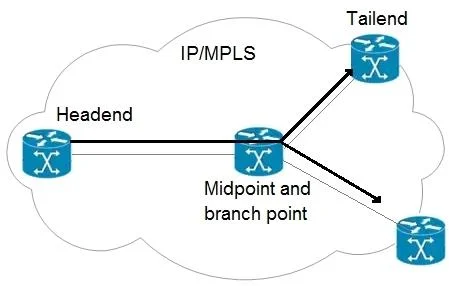
Options
- Aheadend
- Bsource
- Ctransit
- Dbud
How the community answered
(26 responses)- A12% (3)
- B4% (1)
- C8% (2)
- D77% (20)
Explanation
In MPLS P2MP TE, a bud node is uniquely capable of functioning as both a midpoint router (forwarding traffic to downstream branches) and a tail-end router (receiving and delivering traffic locally) simultaneously - no other node type in the P2MP architecture combines these two roles.
Why the distractors are wrong:
- (A) Headend is the ingress/source of the P2MP TE tunnel - it originates and signals the LSP tree, but never acts as a midpoint or tail-end.
- (B) Source is effectively synonymous with headend in P2MP context - it's the root of the tree and only originates traffic.
- (C) Transit routers are pure midpoints - they replicate and forward traffic downstream but do not deliver traffic locally; they cannot be a tail-end.
Memory tip: Think of a bud on a tree branch - it sits in the middle of the branch (midpoint) but can also bloom into a leaf (become a destination). A bud node "buds off" traffic for local delivery while still branching it forward, making it the only dual-role node in P2MP TE topology.
Topics
Community Discussion
No community discussion yet for this question.