
300-515 · Question #81
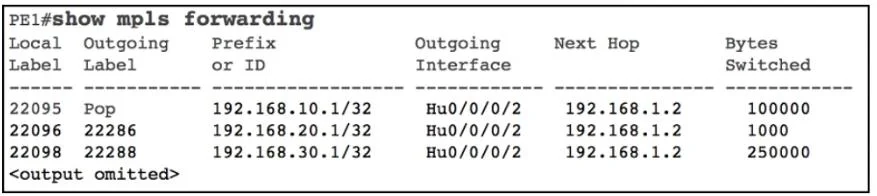
Refer to the exhibit. What is shown in this output?
The correct answer is D. the labels received and advertised on PE1. Option D is correct because the exhibit displays the MPLS label bindings table on PE1, showing the labels PE1 has received from its LDP neighbors (local bindings) and the labels it has advertised to those neighbors - both directions of label exchange as seen from PE1's…
Question
Refer to the exhibit. What is shown in this output?
Exhibit
Options
- Alocal and outgoing abels are updated in hardware
- BBGP is used between neighbors that are exchanging MPLS labels
- CLDP neighbor statuses
- Dthe labels received and advertised on PE1
How the community answered
(35 responses)- A3% (1)
- B9% (3)
- C3% (1)
- D86% (30)
Explanation
Option D is correct because the exhibit displays the MPLS label bindings table on PE1, showing the labels PE1 has received from its LDP neighbors (local bindings) and the labels it has advertised to those neighbors - both directions of label exchange as seen from PE1's perspective.
Why the distractors are wrong:
- A is wrong because the output shows label bindings (control plane), not confirmation that labels have been installed or updated in hardware (data plane).
- B is wrong because standard MPLS label exchange between PE/P routers uses LDP (or RSVP-TE), not BGP. BGP carries labels only in specific scenarios like BGP Labeled Unicast or L3VPN, which isn't what a standard label binding table output represents.
- C is wrong because neighbor status (session state: Up/Down) is a separate concern shown by commands like
show mpls ldp neighbor- the exhibit shows label bindings, not session health.
Memory tip: Think "PE1's Perspective = D for Distribution" - the output is PE1's label Distribution table, showing what it received and what it sent out. If the question asks "what does PE1 know about labels?", answer D.
Topics
Community Discussion
No community discussion yet for this question.