
300-510 · Question #47
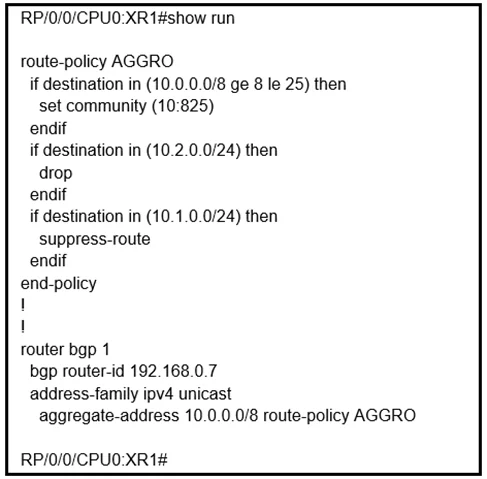
Refer to the exhibit. A network operator is working to filter routes from being advertised that are covered under an aggregate announcement. The receiving router of the aggregate announcement block…
The correct answer is A. Configure the summary-only keyword on the aggregate command. The BGP aggregate-address command with the summary-only keyword suppresses all more-specific routes that fall within the aggregate prefix range. Without this keyword, BGP advertises both the aggregate and the individual component routes. Adding summary-only ensures only the…
Question
Refer to the exhibit. A network operator is working to filter routes from being advertised that are covered under an aggregate announcement. The receiving router of the aggregate announcement block is still getting some of the more specific routes plus the aggregate. Which configuration change ensures that only the aggregate is announced now and in the future if other networks are to be added?
Exhibit
Options
- AConfigure the summary-only keyword on the aggregate command
- BSet each specific route in the AGGRO policy to drop instead of suppress-route
- CFilter the routes on the receiving router
- DSet each specific route in the AGGRO policy to remove instead of suppress-route
How the community answered
(19 responses)- A89% (17)
- C5% (1)
- D5% (1)
Explanation
The BGP aggregate-address command with the summary-only keyword suppresses all more-specific routes that fall within the aggregate prefix range. Without this keyword, BGP advertises both the aggregate and the individual component routes. Adding summary-only ensures only the aggregate is sent to neighbors, and any future more-specific prefixes added under the aggregate will also be automatically suppressed - making it a scalable, forward-looking solution. Option B is wrong because 'suppress-route' is the correct action keyword; changing it to 'drop' would discard routes locally rather than suppress their advertisement. Option C is wrong because filtering on the receiving router is not scalable and doesn't fix the problem at the source. Option D is wrong because 'remove' is not a valid action keyword in this BGP policy context.
Topics
Community Discussion
No community discussion yet for this question.