
300-510 · Question #253
Refer to the exhibit. All routers in the network are in area 12, with IS-IS running in the default configuration as the IGP. To avoid congestion on the link from R1 to R2, the network architect…
The correct answer is C. Change the cost on the link from R1 to R2 to 11 and enable narrow metrics. IS-IS uses default wide metrics to calculate the shortest path, and costs are additive across links. By default, the IS-IS metric is based on the cost assigned to each link. The link from R1 to R4 was configured with a metric of 15, but traffic is still passing through R1 → R2…
Question
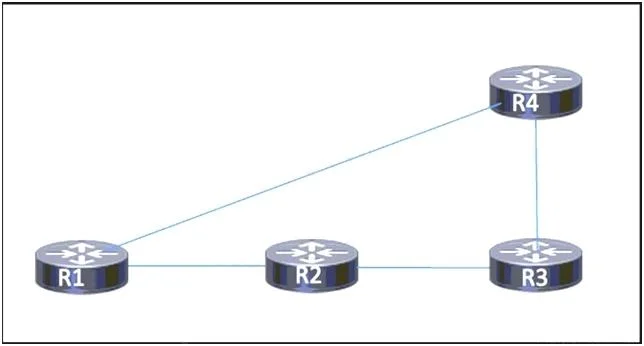
Refer to the exhibit. All routers in the network are in area 12, with IS-IS running in the default configuration as the IGP. To avoid congestion on the link from R1 to R2, the network architect planned for traffic from R1 to R3 to pass through R4. To meet the requirement, a network engineer set the metric from R1 to R4 to a cost of 15, but the traffic is still travelling through R2. Which action must the engineer take to resolve the issue?
Exhibit
Options
- AChange the cost on the link from R1 to R4 to 5.
- BChange the IS-IS administrative distance to 10.
- CChange the cost on the link from R1 to R2 to 11 and enable narrow metrics.
- DChange the default metric to 20 on all links and disable wide area metrics.
How the community answered
(24 responses)- A8% (2)
- B25% (6)
- C63% (15)
- D4% (1)
Explanation
IS-IS uses default wide metrics to calculate the shortest path, and costs are additive across links. By default, the IS-IS metric is based on the cost assigned to each link. The link from R1 to R4 was configured with a metric of 15, but traffic is still passing through R1 → R2 → R3. This indicates that the cost of R1 → R2 → R3 is still lower than the R1 → R4 → R3 Increasing the cost on the link R1 → R2 to 11, which makes it less preferred. Enabling narrow metrics ensures that IS-IS calculates costs using a smaller range of values (1-63), which is often simpler for controlling traffic flows.
Topics
Community Discussion
No community discussion yet for this question.