
300-510 · Question #251
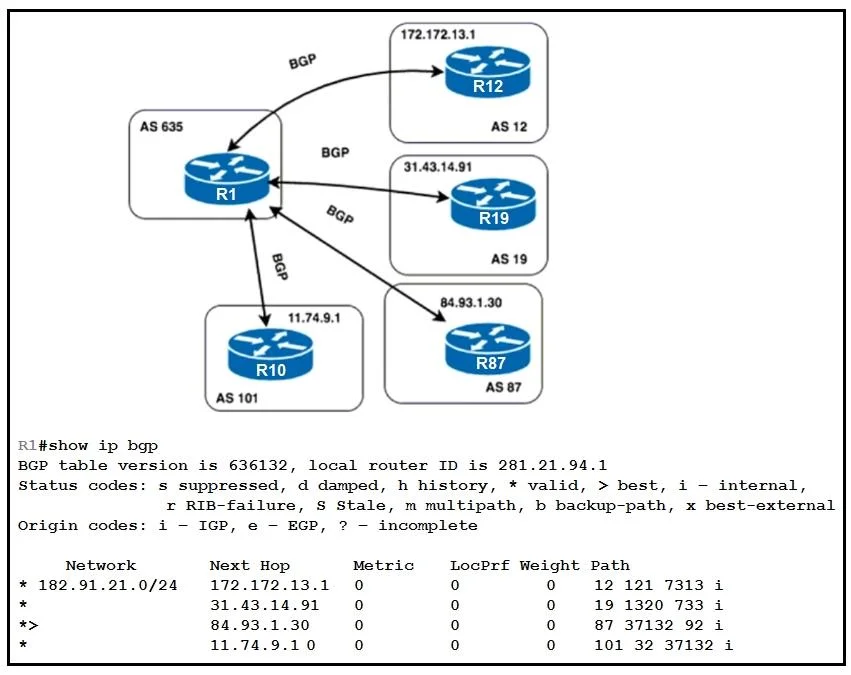
Refer to the exhibit. ISP_A in AS 635 has four BGP neighbors connected one-by-one, starting from AS 12. R1 has been configured with bgp deterministic-med and bgp additional-paths install to…
The correct answer is B. bgp bestpath compare-routerid. Option B (bgp bestpath compare-routerid) is correct because when R10 reloaded, its BGP session reset, causing IOS to prefer the oldest (first-received) path by default when all other attributes are equal - shifting traffic to AS 87. Enabling compare-routerid replaces the…
Question
Refer to the exhibit. ISP_A in AS 635 has four BGP neighbors connected one-by-one, starting from AS 12. R1 has been configured with bgp deterministic-med and bgp additional-paths install to influence egress traffic. After a recent reload of R10, all traffic was automatically re-routed via AS 87. A network engineer must correct the traffic flow and route the traffic via AS 101. Which configuration must the engineer apply to R1 to correct the problem without affecting the second BGP attribute?
Exhibit
Options
- Abgp bestpath med missing-as-worst
- Bbgp bestpath compare-routerid
- Cbgp always-compare-med
- Dbgp default local-preference 200
How the community answered
(20 responses)- A30% (6)
- B45% (9)
- C15% (3)
- D10% (2)
Explanation
Option B (bgp bestpath compare-routerid) is correct because when R10 reloaded, its BGP session reset, causing IOS to prefer the oldest (first-received) path by default when all other attributes are equal - shifting traffic to AS 87. Enabling compare-routerid replaces the "oldest path wins" tiebreaker with a deterministic rule: always prefer the path from the peer with the lowest BGP Router ID, restoring consistent selection toward AS 101.
Why the distractors fail:
- A (
med missing-as-worst) treats an absent MED as the highest (worst) value during MED comparison - it addresses a missing-MED edge case, not a router ID tiebreaker issue caused by a reload. - C (
always-compare-med) removes the restriction that MED is only compared between paths from the same AS - it changes MED comparison scope, not how the final tiebreaker is resolved. - D (
default local-preference 200) raises the default Local Preference, which is the second BGP decision attribute - the question explicitly forbids affecting it, disqualifying this option entirely.
Memory tip: Think "reload = router ID changed = tie broken differently." compare-routerid makes the tiebreaker deterministic and reload-proof by anchoring the decision to a fixed numerical value (lowest RID wins) rather than path age.
Topics
Community Discussion
No community discussion yet for this question.