
300-510 · Question #201
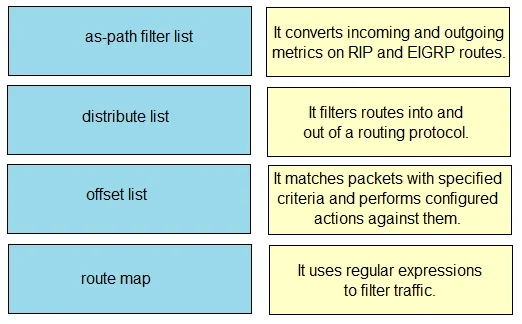
Drag and Drop Question Drag and drop the route-manipulation methods from the left onto their features on the right. Answer:
The correct answer is as-path filter list; distribute list; offset list; route map. This drag-and-drop question assesses knowledge of various network route-manipulation methods, requiring the test-taker to match each method to its primary feature.
Question
Drag and Drop Question Drag and drop the route-manipulation methods from the left onto their features on the right. Answer:
Exhibit
Answer Area
Drag items
Correct arrangement
- as-path filter list
- distribute list
- offset list
- route map
Explanation
This drag-and-drop question assesses knowledge of various network route-manipulation methods, requiring the test-taker to match each method to its primary feature.
Approach. The correct approach is to drag each route-manipulation method from the left column to its corresponding feature description in the right column, based on its specific function:
-
Drag 'as-path filter list' to 'It uses regular expressions to filter traffic.'
- Reasoning: AS-path filter lists are primarily used in Border Gateway Protocol (BGP) to filter routes based on the AS_PATH attribute. They commonly employ regular expressions to define patterns of Autonomous System numbers in the path, making this a distinct feature of AS-path filtering.
-
Drag 'distribute list' to 'It filters routes into and out of a routing protocol.'
- Reasoning: Distribute lists are used with interior gateway protocols (IGPs) like RIP, EIGRP, and OSPF to control which routes are advertised or accepted by a router. They act as a basic filter, allowing or denying routes based on criteria like an access list or prefix list.
-
Drag 'offset list' to 'It converts incoming and outgoing metrics on RIP and EIGRP routes.'
- Reasoning: Offset lists are specific to RIP and EIGRP routing protocols. They are used to add an 'offset' (an increase or decrease) to the metric of routes, thereby influencing path selection by making certain routes appear more or less desirable.
-
Drag 'route map' to 'It matches packets with specified criteria and performs configured actions against them.'
- Reasoning: Route maps are highly versatile and powerful policy-based tools. They consist of a sequence of match clauses (which can evaluate various criteria related to routes, or even packets in policy-based routing contexts) and set clauses (which define actions to take). This description accurately captures the conditional matching and action-taking capabilities of a route map, which can manipulate routes, redistribute them, or even direct packet forwarding.
Common mistakes.
- common_mistake. A common mistake is confusing the specific applications of each method. For example, incorrectly associating 'route map' with simple filtering ('It filters routes into and out of a routing protocol.') which is the primary function of a 'distribute list'. Another mistake might be applying the metric manipulation of 'offset list' to all routing protocols instead of just RIP and EIGRP, or failing to recognize the unique regular expression capability of 'as-path filter lists'. Misattributing the broad 'match and perform action' capability of a 'route map' to a more limited mechanism would also be incorrect.
Concept tested. Route manipulation and filtering techniques in network routing protocols, including AS-path filtering in BGP, distribute lists for general route filtering, offset lists for metric manipulation in RIP/EIGRP, and the versatile policy-based capabilities of route maps.
Topics
Community Discussion
No community discussion yet for this question.