
300-510 · Question #189
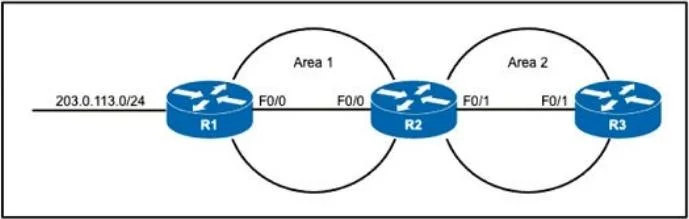
Refer to the exhibit. After recent configuration changes to a customer's network, a network engineer notices that R2 cannot communicate with R3. Both FastEthernet interfaces on R2 and R3 are up and…
The correct answer is D. Configure a loopback interface on R2 and assign it to area 0. Option D is correct because OSPF requires every ABR (Area Border Router) to have at least one interface connected to Area 0 (the backbone). If R2 is acting as the ABR between Area 0 and Area 2 (where R3 resides) but has no interface in Area 0, it cannot perform inter-area…
Question
Refer to the exhibit. After recent configuration changes to a customer's network, a network engineer notices that R2 cannot communicate with R3. Both FastEthernet interfaces on R2 and R3 are up and configured with the correct IP addresses. MD5 password configured on R2 and R3 match with no issues. What is the minimum change the engineer must make to enable R2 and R3 to communicate and fix the problem?
Exhibit
Options
- AConfigure virtual links between R1 and R3.
- BConfigure interface F0/0 on R1 and R2 to be in area 0.
- CDefine area 2 as a NSSA on R2 and R3.
- DConfigure a loopback interface on R2 and assign it to area 0.
How the community answered
(27 responses)- A4% (1)
- B11% (3)
- C7% (2)
- D78% (21)
Explanation
Option D is correct because OSPF requires every ABR (Area Border Router) to have at least one interface connected to Area 0 (the backbone). If R2 is acting as the ABR between Area 0 and Area 2 (where R3 resides) but has no interface in Area 0, it cannot perform inter-area routing - adding a loopback assigned to Area 0 is the minimal change that gives R2 backbone membership and restores reachability to R3.
Why the distractors are wrong:
- A (Virtual links): Virtual links are a workaround for a discontiguous Area 0 and must be configured between two ABRs, not an end router like R3 - this doesn't solve the problem here.
- B (Move F0/0 on R1 and R2 to Area 0): Changing an interface already involved in adjacencies would break existing OSPF neighbor relationships, particularly R2's link to R3 in Area 2, making things worse rather than better.
- C (NSSA): A Not-So-Stubby Area is only needed when an area has an ASBR injecting external routes while also needing stub-like filtering - there's no ASBR scenario described here.
Memory tip: Remember the OSPF golden rule - "all roads lead through Area 0." If an ABR is missing its backbone connection, a loopback interface is the surgeon's scalpel: it adds Area 0 membership without disturbing any existing interfaces or adjacencies.
Topics
Community Discussion
No community discussion yet for this question.