
300-510 · Question #188
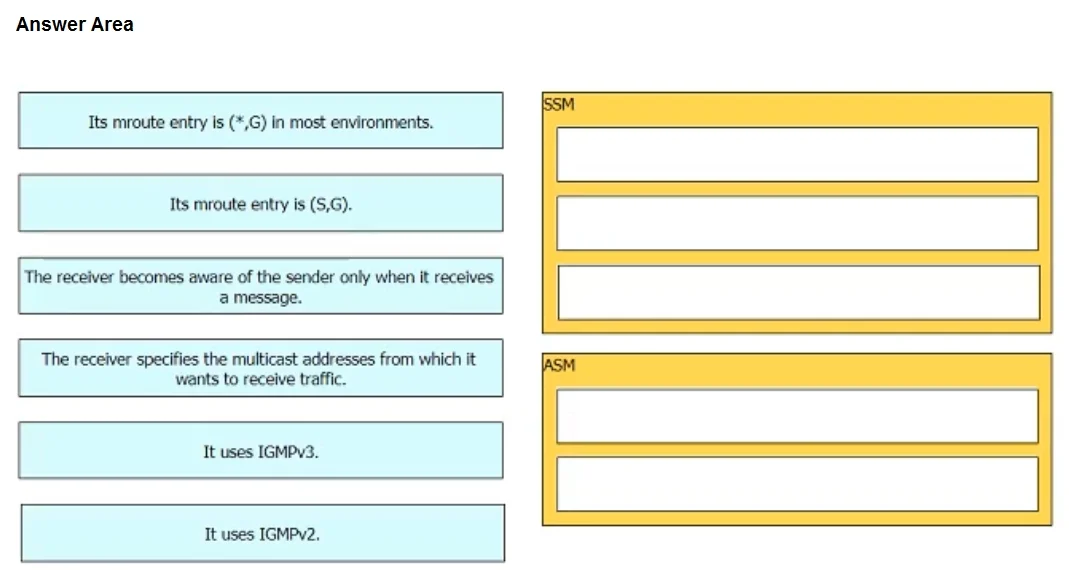
Drag and Drop Question Drag and drop the features about multicast from the left onto the multicast protocols on the right. Not all options ate used. Answer:
The correct answer is weight; local preference; AS path; origin; multiexit discriminator. This question tests the understanding of the key differences and features of Source-Specific Multicast (SSM) and Any-Source Multicast (ASM) protocols.
Question
Drag and Drop Question Drag and drop the features about multicast from the left onto the multicast protocols on the right. Not all options ate used. Answer:
Exhibit
Answer Area
Drag items
Correct arrangement
- weight
- local preference
- AS path
- origin
- multiexit discriminator
Explanation
This question tests the understanding of the key differences and features of Source-Specific Multicast (SSM) and Any-Source Multicast (ASM) protocols.
Approach. The correct approach is to drag each feature description to the multicast protocol (SSM or ASM) it accurately describes, based on their fundamental operational differences.
For SSM (Source-Specific Multicast):
- Drag 'Its mroute entry is (S,G).' to SSM. Explanation: SSM explicitly includes the source (S) along with the group (G) in its routing table entries because receivers specify the source they wish to receive from.
- Drag 'It uses IGMPv3.' to SSM. Explanation: IGMPv3 is the version of IGMP that introduced the ability for hosts to specify source addresses, which is essential for SSM functionality.
- Drag 'The receiver specifies the multicast addresses from which it wants to receive traffic.' to SSM. Explanation: This is a defining characteristic of SSM, where the receiver precisely indicates the source(s) and group(s) it's interested in.
For ASM (Any-Source Multicast):
- Drag 'Its mroute entry is (,G) in most environments.' to ASM. Explanation: ASM routes traffic based on the group (G) irrespective of the source, denoted by the wildcard '' (any source).
- Drag 'It uses IGMPv2.' to ASM. Explanation: IGMPv2 (and IGMPv1) are commonly used with ASM, as they allow joining a multicast group but do not support source-specific filtering.
Unused Option:
- 'The receiver becomes aware of the sender only when it receives a message.' is left unused. While this statement generally applies more to ASM than SSM in a broad sense (as ASM doesn't pre-specify sources), it's not as definitive a differentiator as the other options and is explicitly not used in the correct solution provided.
Common mistakes.
- common_mistake. Common mistakes include confusing the IGMP versions with the multicast modes (e.g., associating IGMPv3 with ASM) or misinterpreting the mroute entry formats (,G vs. S,G). For instance, dragging 'Its mroute entry is (S,G)' to ASM would be incorrect because ASM is source-independent, using (,G). Similarly, dragging 'It uses IGMPv2' to SSM is wrong because SSM requires IGMPv3 for source filtering. Another mistake could be trying to use all options, specifically placing 'The receiver becomes aware of the sender only when it receives a message.' when the question states not all options are used and it's less precise than the other options for distinguishing the two.
Concept tested. The core concept tested is the fundamental understanding of multicast routing protocols, specifically the differences between Any-Source Multicast (ASM) and Source-Specific Multicast (SSM), including their routing table entries, the role of IGMP versions, and how receivers interact with senders in each model.
Topics
Community Discussion
No community discussion yet for this question.