
300-510 · Question #180
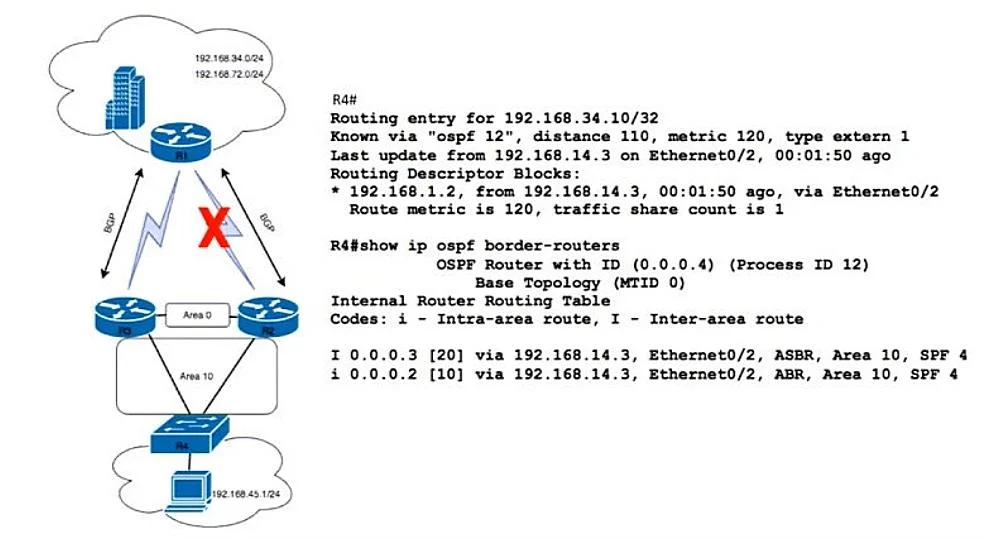
Refer to the exhibit. After a recent network implementation project, customer A is performing stress testing to verify network redundancy at the branch office connected to R4. When the link from R2…
The correct answer is B. Redistribute routes from BGP to OSPF as type E1. This scenario involves OSPF external route redistribution from BGP, and the behavior difference between OSPF external type E1 and E2 routes. When BGP routes are redistributed into OSPF as the default type E2, the external metric is fixed and does not accumulate internal OSPF…
Question
Refer to the exhibit. After a recent network implementation project, customer A is performing stress testing to verify network redundancy at the branch office connected to R4. When the link from R2 is shut down as shown, the SLA tracking object fails and the cost of the link between R2 and R4 increases to 100. However, a traceroute operation from a PC in the branch office shows that traffic to HQ is still routed via R2. Which solution corrects the problem and optimizes traffic flow via R3 without creating operational overhead?
Exhibit
Options
- AConfigure two OSPF processes on R2 and R3 and redistribute traffic between them.
- BRedistribute routes from BGP to OSPF as type E1.
- CUse multiarea adjacency to extend Area 10 to the link between R2 and R3.
- DCreate a virtual channel from R3 to R4.
How the community answered
(19 responses)- A5% (1)
- B74% (14)
- C16% (3)
- D5% (1)
Explanation
This scenario involves OSPF external route redistribution from BGP, and the behavior difference between OSPF external type E1 and E2 routes. When BGP routes are redistributed into OSPF as the default type E2, the external metric is fixed and does not accumulate internal OSPF costs. So even when the SLA tracking object raises R2's link cost to 100, the E2 route via R2 still has the same external metric as the E2 route via R3 - OSPF cannot differentiate them based on internal path cost, so the original path via R2 may persist. Redistributing as type E1 changes this behavior: the total cost of an E1 route equals the external metric plus the cumulative internal OSPF cost to reach the ASBR. When R2's internal link cost increases to 100, the E1 route through R2 becomes more expensive than the E1 route through R3, causing OSPF to correctly prefer R3. Option A (two OSPF processes with redistribution) adds unnecessary complexity. Option C (multiarea adjacency) does not solve the metric comparison problem. Option D ('virtual channel') is not a standard OSPF mechanism.
Topics
Community Discussion
No community discussion yet for this question.