
300-420 · Question #115
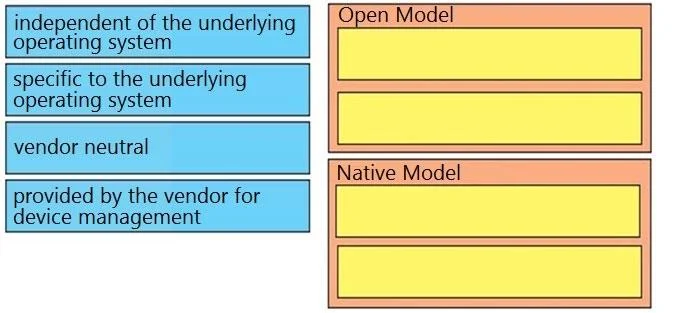
Drag and Drop Question Drag and drop the characteristics from the left onto the Yang model they describe on the right. Answer:
The correct answer is independent of the underlying operating system; vendor neutral; specific to the underlying operating system; provided by the vendor for device management. This drag-and-drop question tests the understanding of the characteristics that distinguish Open Models from Native Models in the context of YANG data modeling for network device management.
Question
Drag and Drop Question Drag and drop the characteristics from the left onto the Yang model they describe on the right. Answer:
Exhibit
Answer Area
Drag items
Correct arrangement
- independent of the underlying operating system
- vendor neutral
- specific to the underlying operating system
- provided by the vendor for device management
Explanation
This drag-and-drop question tests the understanding of the characteristics that distinguish Open Models from Native Models in the context of YANG data modeling for network device management.
Approach. To answer correctly, drag 'independent of the underlying operating system' and 'vendor neutral' to the 'Open Model' section. Then, drag 'specific to the underlying operating system' and 'provided by the vendor for device management' to the 'Native Model' section. This is correct because Open Models (also known as standard or community models) are developed by standards bodies or open-source communities, aiming for vendor neutrality and independence from specific operating systems to ensure interoperability across diverse equipment. Conversely, Native Models (also known as vendor-specific or proprietary models) are created by individual vendors for their own devices, meaning they are intrinsically tied to that vendor's underlying operating system and management frameworks.
Common mistakes.
- common_mistake. A common mistake is to confuse the characteristics, for example, placing 'vendor neutral' under 'Native Model' or 'specific to the underlying operating system' under 'Open Model'. This is incorrect because native models are by definition vendor-specific and tied to their proprietary implementation, while open models are designed for broad interoperability across different vendors and operating systems. Misplacing these characteristics indicates a misunderstanding of the fundamental purpose and scope of each model type.
Concept tested. YANG data models, specifically the distinction between Open Models (standard, vendor-neutral, OS-independent) and Native Models (vendor-specific, proprietary, OS-dependent) in network programmability and automation.
Topics
Community Discussion
No community discussion yet for this question.