
300-420 · Question #116
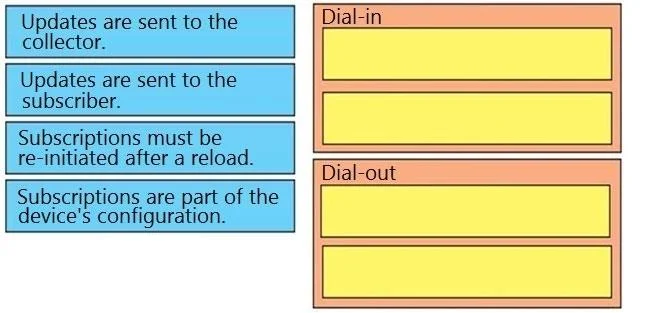
Drag and Drop Question Drag and drop the model driven telemetry characteristics from the left onto the mode they belong to on the right. Answer:
The correct answer is Updates are sent to the subscriber.; Subscriptions must be re-initiated after a reload.; Updates are sent to the collector.; Subscriptions are part of the device's configuration. The question tests understanding of model-driven telemetry's dial-in and dial-out modes, specifically how subscriptions are managed and where updates are sent in each mode.
Question
Drag and Drop Question Drag and drop the model driven telemetry characteristics from the left onto the mode they belong to on the right. Answer:
Exhibit
Answer Area
Drag items
Correct arrangement
- Updates are sent to the subscriber.
- Subscriptions must be re-initiated after a reload.
- Updates are sent to the collector.
- Subscriptions are part of the device's configuration.
Explanation
The question tests understanding of model-driven telemetry's dial-in and dial-out modes, specifically how subscriptions are managed and where updates are sent in each mode.
Approach. The correct interaction is to drag the characteristics to their respective categories as follows:
Dial-in:
- 'Updates are sent to the subscriber.'
- 'Subscriptions must be re-initiated after a reload.'
Reasoning: In dial-in mode, the telemetry collector or subscriber initiates the connection to the network device and requests specific data. The device then sends the requested updates back to the requesting subscriber. These subscriptions are typically initiated by the collector and are not permanently configured on the device itself. Therefore, if the device reloads or the connection is lost, the subscriber must re-initiate the subscription to receive data.
Dial-out:
- 'Updates are sent to the collector.'
- 'Subscriptions are part of the device's configuration.'
Reasoning: In dial-out mode, the network device initiates the connection to a telemetry collector and pushes data to it. The subscriptions, specifying what data to send, are configured directly on the network device as part of its running configuration. Since the device itself is configured to stream data to a collector, it sends updates to the collector. These configurations persist across reloads because they are part of the device's persistent configuration.
Common mistakes.
- common_mistake. A common mistake is confusing which entity initiates the connection and, consequently, which entity is the 'subscriber' versus the 'collector' for updates, or how subscriptions are managed. For example, placing 'Updates are sent to the collector' under Dial-in would be incorrect because in dial-in, the collector pulls data, and the device sends it to the entity that initiated the pull (the subscriber, which is the collector). Placing 'Subscriptions are part of the device's configuration' under Dial-in is incorrect because dial-in subscriptions are dynamically requested by the collector, not hard-coded on the device. Similarly, putting 'Subscriptions must be re-initiated after a reload' under Dial-out is wrong because dial-out subscriptions, being part of the device's configuration, typically persist across reloads.
Concept tested. Model-Driven Telemetry (MDT) modes: Dial-in versus Dial-out, including how data updates are sent and how subscriptions are managed in each mode.
Topics
Community Discussion
No community discussion yet for this question.