
300-420 · Question #175
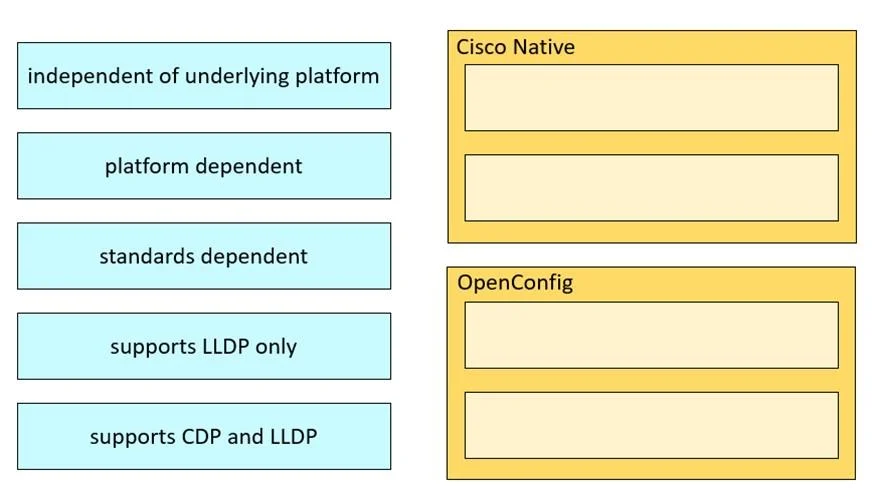
Drag and Drop Question Drag and drop the characteristics from the left onto the YANG models they describe on the right. Not all options are used. Answer:
The correct answer is performs the initial authentication of WAN Edge devices; provides a GUI interface to monitor, configure, and maintain the SD-WAN devices; responsible for the control plane. This question tests the understanding of key characteristics differentiating Cisco Native and OpenConfig YANG data models, particularly their platform dependency and support for discovery protocols.
Question
Drag and Drop Question Drag and drop the characteristics from the left onto the YANG models they describe on the right. Not all options are used. Answer:
Exhibit
Answer Area
Drag items
Correct arrangement
- performs the initial authentication of WAN Edge devices
- provides a GUI interface to monitor, configure, and maintain the SD-WAN devices
- responsible for the control plane
Explanation
This question tests the understanding of key characteristics differentiating Cisco Native and OpenConfig YANG data models, particularly their platform dependency and support for discovery protocols.
Approach. The correct interaction is to drag 'platform dependent' and 'supports CDP and LLDP' to the 'Cisco Native' box, and 'independent of underlying platform' and 'supports LLDP only' to the 'OpenConfig' box. The characteristic 'standards dependent' remains unused. This is correct because: - Cisco Native YANG models are proprietary and designed specifically for Cisco devices, making them 'platform dependent'. Cisco devices traditionally support both the proprietary Cisco Discovery Protocol (CDP) and the industry-standard Link Layer Discovery Protocol (LLDP), so 'supports CDP and LLDP' is appropriate. - OpenConfig YANG models are open, vendor-neutral, and designed to manage network devices regardless of the underlying vendor's platform, making them 'independent of underlying platform'. OpenConfig focuses on open standards; therefore, when it comes to neighbor discovery, it would typically manage standard protocols like LLDP and not proprietary ones like CDP, hence 'supports LLDP only'. - The option 'standards dependent' is generally applicable to networking but less specific as a distinguishing feature between these two model types, making it the most likely unused option in this context.
Common mistakes.
- common_mistake. A common mistake would be to confuse the platform dependency or the supported discovery protocols. For instance, dragging 'independent of underlying platform' to Cisco Native or 'platform dependent' to OpenConfig demonstrates a fundamental misunderstanding of the purpose and design philosophy of these two types of YANG models. Similarly, incorrectly assigning 'supports LLDP only' to Cisco Native or 'supports CDP and LLDP' to OpenConfig would be wrong because OpenConfig prioritizes open standards (like LLDP), while Cisco's native models would encompass both its proprietary (CDP) and standard (LLDP) protocols. Another mistake could be trying to use all options, particularly misplacing 'standards dependent' which, while partially true for OpenConfig, is not the best fit among the given, more specific, distinguishing characteristics.
Concept tested. The core concept being tested is the understanding of different types of YANG data models used in network programmability, specifically distinguishing between vendor-specific (Cisco Native) and vendor-neutral (OpenConfig) models, including their platform dependencies and support for standard versus proprietary protocols like LLDP and CDP.
Topics
Community Discussion
No community discussion yet for this question.