
300-420 · Question #227
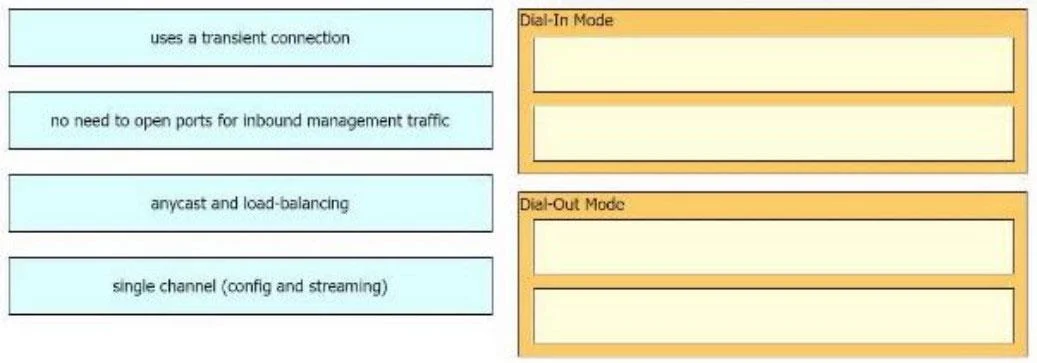
Drag and Drop Question Drag and drop the model-driven telemetry considerations from the left onto the modes they apply to on the right. Answer:
The correct answer is uses a transient connection; single channel (config and streaming); anycast and load-balancing; no need to open ports for inbound management traffic. This question assesses the test-taker's understanding of the key characteristics and operational differences between Dial-In and Dial-Out modes in model-driven telemetry (MDT).
Question
Drag and Drop Question Drag and drop the model-driven telemetry considerations from the left onto the modes they apply to on the right. Answer:
Exhibit
Answer Area
Drag items
Correct arrangement
- uses a transient connection
- single channel (config and streaming)
- anycast and load-balancing
- no need to open ports for inbound management traffic
Explanation
This question assesses the test-taker's understanding of the key characteristics and operational differences between Dial-In and Dial-Out modes in model-driven telemetry (MDT).
Approach. The correct interaction involves dragging the telemetry considerations to the appropriate mode based on their characteristics:
- 'uses a transient connection' should be dragged to 'Dial-In Mode': In Dial-In mode, the collector initiates the connection. While persistent subscriptions are possible, the collector can also establish connections for specific data pulls that may be short-lived or transient, similar to traditional polling. The collector controls the connection lifecycle.
- 'single channel (config and streaming)' should be dragged to 'Dial-In Mode': Protocols often used in Dial-In, such as NETCONF/YANG over SSH or gRPC, can leverage a single communication channel to handle both configuration commands and streaming telemetry data, simplifying the management plane.
- 'anycast and load-balancing' should be dragged to 'Dial-Out Mode': With Dial-Out mode, network devices initiate connections to collectors. This allows devices to be configured to send data to an anycast IP address, which can then distribute the telemetry streams across multiple collectors for automatic load balancing and enhanced redundancy.
- 'no need to open ports for inbound management traffic' should be dragged to 'Dial-Out Mode': A significant security advantage of Dial-Out mode is that the network device initiates the connection outbound to the collector. This means the device's firewall does not need to have inbound ports opened for telemetry traffic, reducing the attack surface and simplifying firewall rule management on the device side.
Common mistakes.
- common_mistake. A common mistake is confusing which entity initiates the connection (collector for Dial-In vs. device for Dial-Out) and the implications of this. For example, incorrectly placing 'no need to open ports for inbound management traffic' under Dial-In Mode would be wrong because Dial-In requires inbound connectivity to the device for the collector to connect. Similarly, attributing 'anycast and load-balancing' to Dial-In would be incorrect, as the device-initiated nature of Dial-Out is what primarily enables this mechanism for telemetry streams. Misinterpreting 'uses a transient connection' by placing it in Dial-Out is also incorrect, as Dial-Out is typically characterized by persistent, continuous data streams from the device, whereas Dial-In can involve collector-initiated, on-demand data requests that might be considered transient.
Concept tested. Model-driven telemetry (MDT) operational modes, specifically the architectural differences and associated considerations for Dial-In (collector-initiated) versus Dial-Out (device-initiated) telemetry, including connection types, security implications (firewall rules), and scalability features (anycast, load-balancing).
Topics
Community Discussion
No community discussion yet for this question.