
300-420 · Question #147
An engineer uses Postman and YANG to configure a router with: - OSPF process ID 100 - network 10.10.10.0/28 enabled for Area 0 Which get-config replay verifies that the model set was designed…
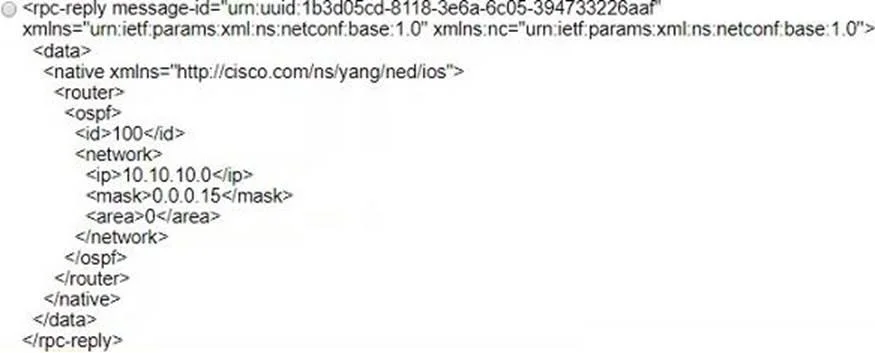
The correct answer is D. <rpc-reply message-id="urn:uuid:1b3d05cd-8118-3e6a-6c05-394733226aaf" xmlns="urn:ietf:params:xml:ns:netconf:base:1.0" xmlns:nc="urn:ietf:params:xml:ns:netconf:base:1.0"> <data> <native xmlns="http://cisco.com/ns/yang/ned/ios"> <router> <ospf> <id>100</id> <network> <ip>10.10.10.0</ip> <mask>0.0.0.15</mask> <area>0</area> </network> </ospf> </router> </native> </data> </rpc-reply>. The correct get-config replay to verify OSPF network configuration with a /28 prefix for Area 0 must show the IP address 10.10.10.0 and a wildcard mask of 0.0.0.15.
Question
An engineer uses Postman and YANG to configure a router with:
- OSPF process ID 100
- network 10.10.10.0/28 enabled for Area 0
Which get-config replay verifies that the model set was designed correctly? A. B. C. D.
Exhibits
Options
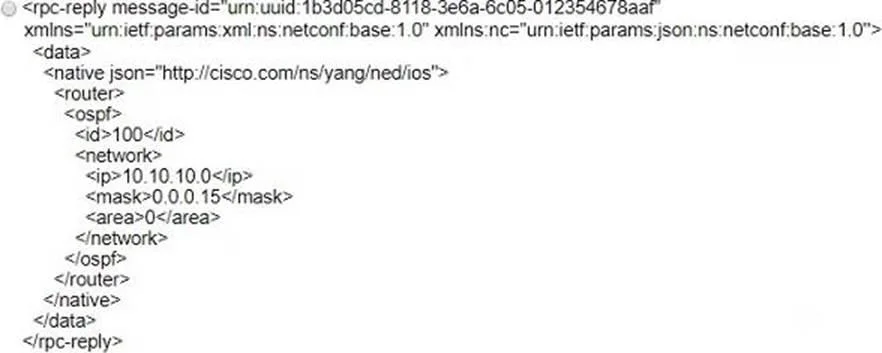
- A<rpc-reply message-id="urn:uuid:1b3d05cd-8118-3e6a-6c05-012354678aaf" xmlns="urn:ietf:params:xml:ns:netconf:base:1.0" xmlns:nc="urn:ietf:params:xml:ns:netconf:base:1.0"> <data> <native xmlns="http://cisco.com/ns/yang/ned/ios"> <router> <ospf> <id>100</id> <network> <ip>10.10.10.0</ip> <mask>0.0.0.15</mask> <area>0</area> </network> </ospf> </router> </native> </data> </rpc-reply>
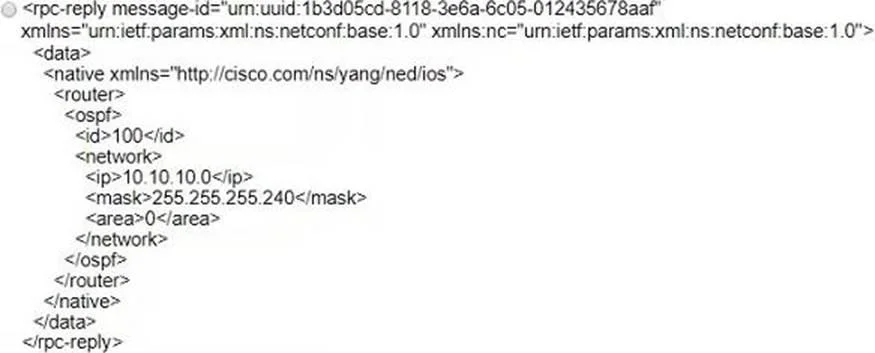
- B<rpc-reply message-id="urn:uuid:1b3d05cd-8118-3e6a-6c05-012435678aaf" xmlns="urn:ietf:params:xml:ns:netconf:base:1.0" xmlns:nc="urn:ietf:params:xml:ns:netconf:base:1.0"> <data> <native xmlns="http://cisco.com/ns/yang/ned/ios"> <router> <ospf> <id>100</id> <network> <ip>10.10.10.0</ip> <mask>255.255.255.240</mask> <area>0</area> </network> </ospf> </router> </native> </data> </rpc-reply>
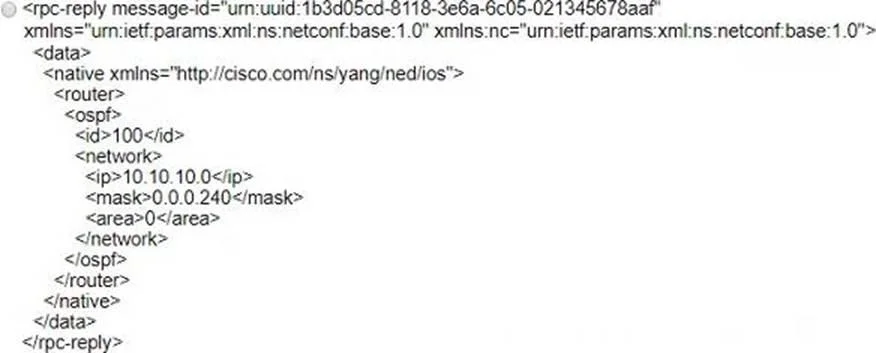
- C<rpc-reply message-id="urn:uuid:1b3d05cd-8118-3e6a-6c05-021345678aaf" xmlns="urn:ietf:params:xml:ns:netconf:base:1.0" xmlns:nc="urn:ietf:params:xml:ns:netconf:base:1.0"> <data> <native xmlns="http://cisco.com/ns/yang/ned/ios"> <router> <ospf> <id>100</id> <network> <ip>10.10.0.0</ip> <mask>0.0.0.240</mask> <area>0</area> </network> </ospf> </router> </native> </data> </rpc-reply>
- D<rpc-reply message-id="urn:uuid:1b3d05cd-8118-3e6a-6c05-394733226aaf" xmlns="urn:ietf:params:xml:ns:netconf:base:1.0" xmlns:nc="urn:ietf:params:xml:ns:netconf:base:1.0"> <data> <native xmlns="http://cisco.com/ns/yang/ned/ios"> <router> <ospf> <id>100</id> <network> <ip>10.10.10.0</ip> <mask>0.0.0.15</mask> <area>0</area> </network> </ospf> </router> </native> </data> </rpc-reply>
How the community answered
(37 responses)- A5% (2)
- B14% (5)
- C3% (1)
- D78% (29)
Why each option
The correct get-config replay to verify OSPF network configuration with a /28 prefix for Area 0 must show the IP address 10.10.10.0 and a wildcard mask of 0.0.0.15.
While the configuration content within the <data> tags in option A is technically identical to option D and thus correct for verifying the OSPF network, option D is specified as the correct answer.
This option incorrectly specifies the 'mask' as 255.255.255.240, which is the subnet mask, not the wildcard mask typically used in Cisco IOS OSPF network commands within YANG models.
This option incorrectly specifies the 'ip' address as 10.10.0.0 instead of 10.10.10.0 and also uses an incorrect wildcard mask of 0.0.0.240, which is not equivalent to a /28 prefix's wildcard mask.
This rpc-reply correctly specifies OSPF process ID 100, the network 10.10.10.0, and a wildcard mask of 0.0.0.15 for Area 0. A /28 CIDR prefix corresponds to a subnet mask of 255.255.255.240, and its inverse, the wildcard mask, is 0.0.0.15, accurately reflecting the desired OSPF network command.
Concept tested: OSPF network command with wildcard mask in YANG/NETCONF
Source: https://www.cisco.com/c/en/us/td/docs/ios-xml/ios/iproute_ospf/configuration/15-mt/iro-15-mt-book.html
Topics
Community Discussion
No community discussion yet for this question.